


Annecy 2026: Mu Yi Review: “Mu Yi Feels Like an Old Wood Carving Come to Life”

© Studio La Cachette
Myth and animation are inherently intertwined. Stories that extend beyond reality to create an analog of the human experience are rarely easily captured by a camera alone, making animation, itself an analog of reality, a natural outlet for retelling ancient tales. History has borne this out, with the earliest animated features being rooted in fairy tales, whether you pinpoint El Apóstol, The Adventures of Prince Achmed or Snow White as the moment where longform animated storytelling began.
The special quality of a great myth or fairytale gives you the sense that you’re experiencing a reality just out of reach, that if you could block out all the noise of life, you could enter a realm of Olympian gods or enchanted forests. In the modern day, that mythic quality clashes brutally with commercialisation, with our modern animated fairytales foregoing that mystery, edge and near-spiritual essence in favour of a focused-grouped product. This is why we should be thankful for the deeply textured, ancient and artful story of Mu Yi.
Rooted in Chinese myth, Mu Yi doesn’t need to transport us to a time and place beyond our understanding to communicate that fairy tale feeling. Instead, the majority of the story takes place in the modern day, following the titular Mu Yi as she looks to reconcile the modern world of commerce and capitalism with the traditional, spiritual and secluded village she lives in. Her cynicism towards spirituality is broken when she encounters a group of performers who put on the tale of the handsome general, a show that confirms the existence of the supernatural. Made for less than €3 million over the course of more than a decade, mostly by director and writer Julien Chheng alone, Mu Yi’s disavowing of the big studio way of making animation is rooted into its existence.
Developed by Chheng and his partner since the early 2010s, Mu Yi’s script is one of its greatest strengths. Setting a story in the modern day with characters speaking like modern people and landing jokes that work for younger and older audiences is difficult when you want something to feel like an unearthed text. Somehow, Mu Yi balances those plates to perfection.
© Studio La Cachette
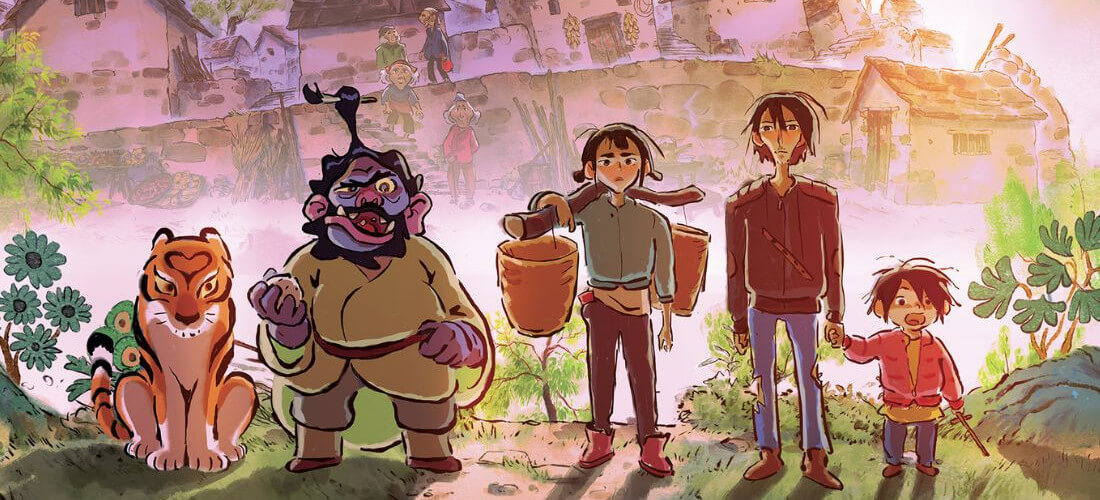
Mu Yi’s character is calibrated perfectly, talking and acting like a moody, rebellious teen who is drawn in by the bright lights of the city but hamstrung by the elders of her village, a simple but effective coming of age setup. Her rebellion lends to a fearlessness and boldness that makes her really easy to root for. She is also deeply sympathetic, with the opening scene depicting a rich tourist from the city degrading Mu Yi while intruding through these ancient villages on a tour bus. Being othered drives Mu Yi’s rejection of her culture, something deeply relatable to those who grew up as minorities. With us so easily able to step into Mu Yi’s shoes, it makes her confrontation of a myth come to life feel even more real to us.
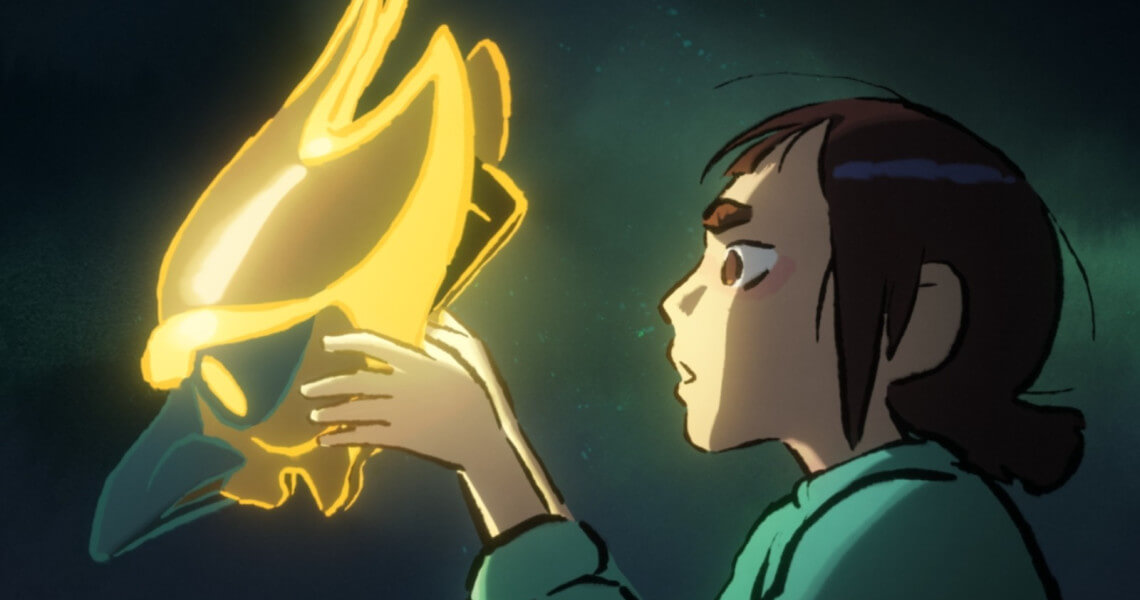
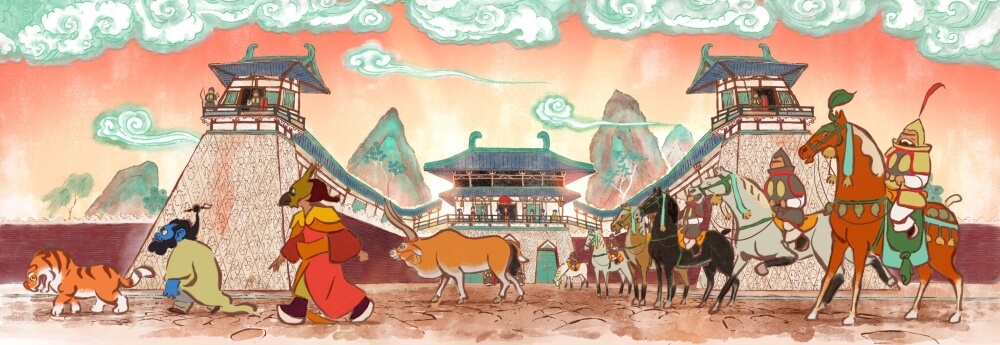
Another great aid in selling the audience on Mu Yi’s mythical nature are the visuals. Being animated alone allows encounters with time-warping objects and demigods to feel like a piece with a world of tour buses and iPhones, but the specific texture brought to the frames is the movie’s true superpower. Crafted by Studio LaCachette, Mu Yi utilises the art style we’ve seen in Primal and their Star Wars: Visions short where thick, inky outlines adorn each character and prop, watercolours almost spill into one another and characters move as if gliding through ink. Mu Yi feels like an old wood carving come to life, with even the composition of the frames evoking that sensation.
© Studio La Cachette
The film has such an interesting relationship to how much detail is in each frame. Sometimes a lack of detail and less saturated colour is used to almost leave blanks in the image and ask the audience to imagine the rest. Other scenes have the frame densely packed with detail and objects and mist, making us want to peer around the image to get a clearer look. Either way, there’s a sense of obfuscation from the audience, something the storyteller is keeping up their sleeve, an invitation to come and live inside the movie, to experience the myth itself, a desire to shut out the noise in the hopes of these magical elements entering your reality.
As much as it is a coming of age story, Mu Yi feels like a commentary on the commercialisation of myth. In a society that is so tech and business forward, we use myth as an escape, we bask in escapism constantly, whether that’s in the form of a film, a book, a game, but all of those things are packaged and sold by corporations. Knowing this, it’s easy to be cynical even about the ones that best replicate that feeling that only a myth can give you. Mu Yi is a reminder of that feeling, detached from corporations, a vision almost entirely from a single person, a dedication to the power of animation to help us grasp that which is just out of reach.