

J.P. Vine on Cardboard

© Locksmith Animation
In this year’s batch of BAFTA nominated shorts, Cardboard stands out for its unique blend of comedy, heart and innocence. Coming from J.P. Vine and Locksmith Animation, who previously teamed up on 2021’s Ron’s Gone Wrong, Cardboard tells the story of a single father pig and his two piglets who are moving into a trailer park after losing both their home and the matriarch of the family. The film paints a starkly honest picture of childhood resilience in the face of challenges they can’t quite understand yet.
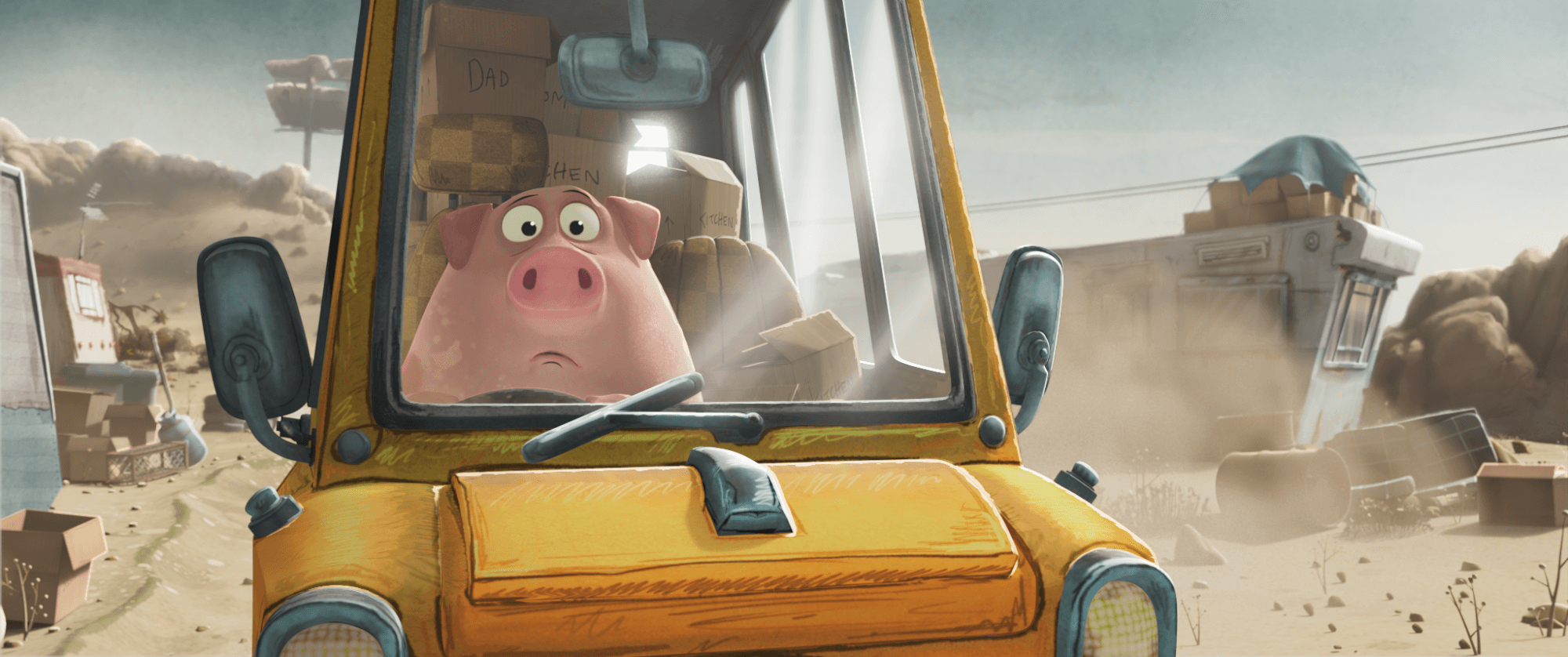
Cardboard is rendered in an art style that blends CG and 2D, adding a homemade feel to the yellow and beige colour palette of the trailer park that sits in the middle of nowhere. As the film takes us into the imagination of the piglets, the 2D animation ramps up, a burst of childhood innocence in the middle of a dire situation.
Skwigly caught up with Vine to chat about the 10 year process of making the film, the emotional backbone of the story and executing the 2D/CG hybrid look.
After finishing Ron’s Gone Wrong, what made you want to make a short rather than another feature?
After Ron I was in feature pitching mode, trying to score my next project. When you’re making a feature, people are asking you about your next idea right at your most exhausted, when you’ve got no ideas. But Cardboard, I’d been tinkering with a way to get it done even in the sort of later stages of Ron. When I moved to London to make the feature, I’d already storyboarded and edited a version of Cardboard. It was just one of those projects that never leaves your mind so it felt really weird to get it to such a kind of refined place in boards, and then leave it.
I’d started having conversations with some independent producers, and was thinking about making it in 2D, maybe partnering with a French studio, trying to find ways to do it by myself. And then, it was through a couple of conversations with Crosby Clyse at DNEG and Julie Lockhart at Locksmith because a few artists that rolled off That Christmas were between projects and could just jump into doing some work. It made sense for Locksmith because there was going to be a big gap between That Christmas and Bad Fairies. And then with DNEG, it was a chance to really work with the team in India, who don’t usually get that face to face director time.
What I decided to do was bring up people on the crew that have proven themselves in the feature world, but were not quite at the level where they want to get to. So my producer was actually the art department manager on Ron and Michaela [Manas Molina] was really driven and really detail orientated, and I just felt like she would make a great partner, even though she had not really carried something through production at all.
© Locksmith Animation
It was a 10 year process to find the partners for this short film from the very first original sketches, which was a bit painful as a process, but it’s encouraging. It’s a weird thing that applies to artists where you get more experience and you can help out what your younger self was trying to do. When you’re young, you’ve got the taste, you’ve got the vision, but you don’t have the execution or the experience to pull it off. So I was helping out J.P. from 10 years ago by getting this short done.
How did that 10 year process begin? Where did Cardboard originate from an emotional standpoint?
I was at Pixar trying to come up with a project to test my skills as a director. I tried something pretty terrible and boring to start with, which was some quite sad story about a pig and a chicken that were in this industrial farm. I guess I was drawing pigs a lot. There’s no other good reason except I like pigs and I find them characterful and expressive. But I abandoned that first project because it just wasn’t going anywhere. I took a road trip with my family and between San Francisco and Salt Lake City, you kind of have these really incredibly empty desert landscapes, which I love because they’re so foreign to my eyes, but cinematic at the same time, wide screen and beautiful. You see these trailer parks dotted around in this absolute nothingness and it just got me thinking about the circumstances that lead someone there.
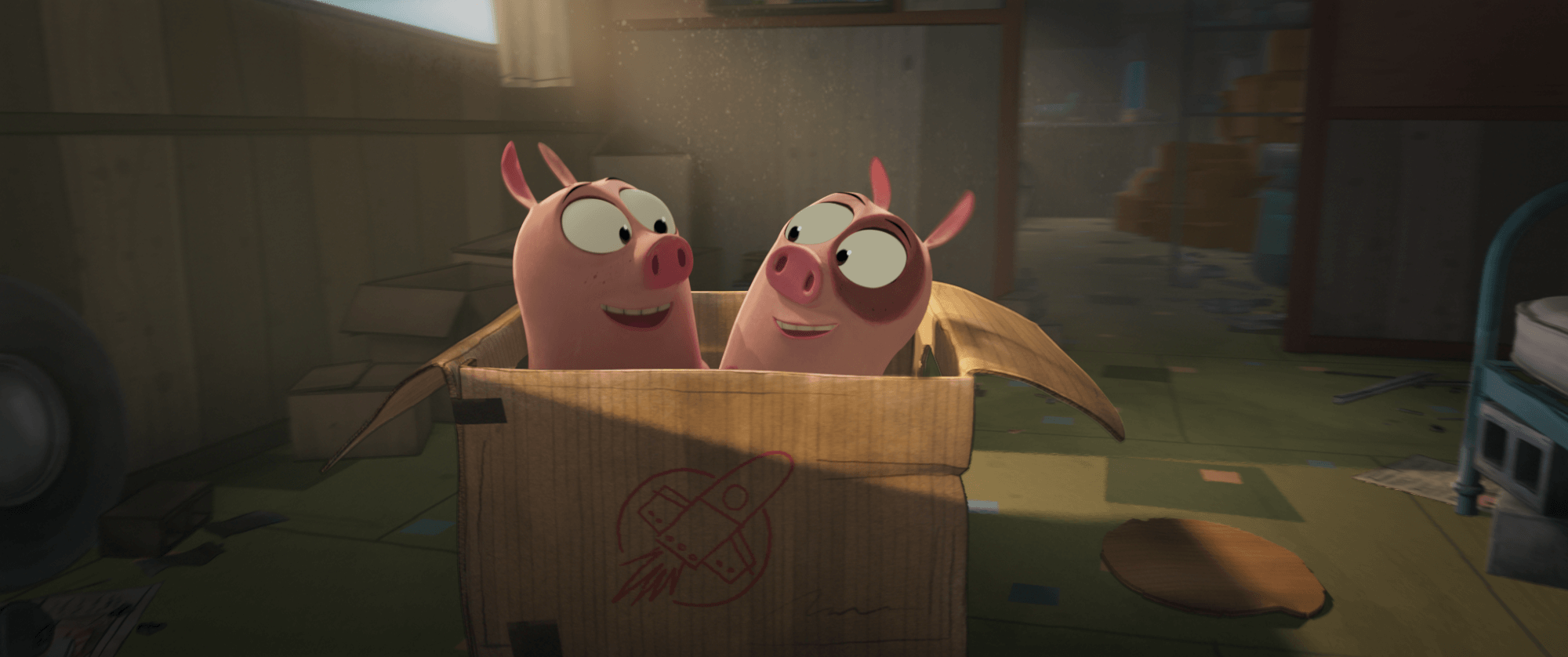
I just started thinking about a family arriving at a trailer park, and fused it with my own experience of my family arriving at a council house which was our new home. As a 10 year old, you’re perceiving a bit of, ‘Hey, are we a bit screwed here? What’s going on? Why are we staying at friends’ houses?’ But then my 10 year old kid resilience just took over, and you just get on with it. I explored the woods every day with the dog and we built a great life there. So once I kind of mulled those ideas over, I had a thematic angle, it was going to be a story about two different perspectives on change. One was that of a parent that’s burdened and struggling, and then the other is the kids who see this change with a sense of opportunity and curiosity.
© Locksmith Animation
How did you go about developing the CG look of the real world combined with 2D brushstroke textures?
I’m really influenced by Raymond Briggs, Quentin Blake, that British tradition of quite loose illustration that’s very characterful and very handmade and I was wanting to explore that in CG. I like feeling the brush work and the hand of the artist, but we needed to find our own version of painterly which wasn’t Spider-Verse or Puss in Boots. I leaned into this inky, illustrative approach to lines and watercolor approach to textures. There’s a wobbly looseness in the way everything’s done, but combining that with a strong sense of atmosphere and lighting was what I was shooting for. I love that irregularity in modeling.
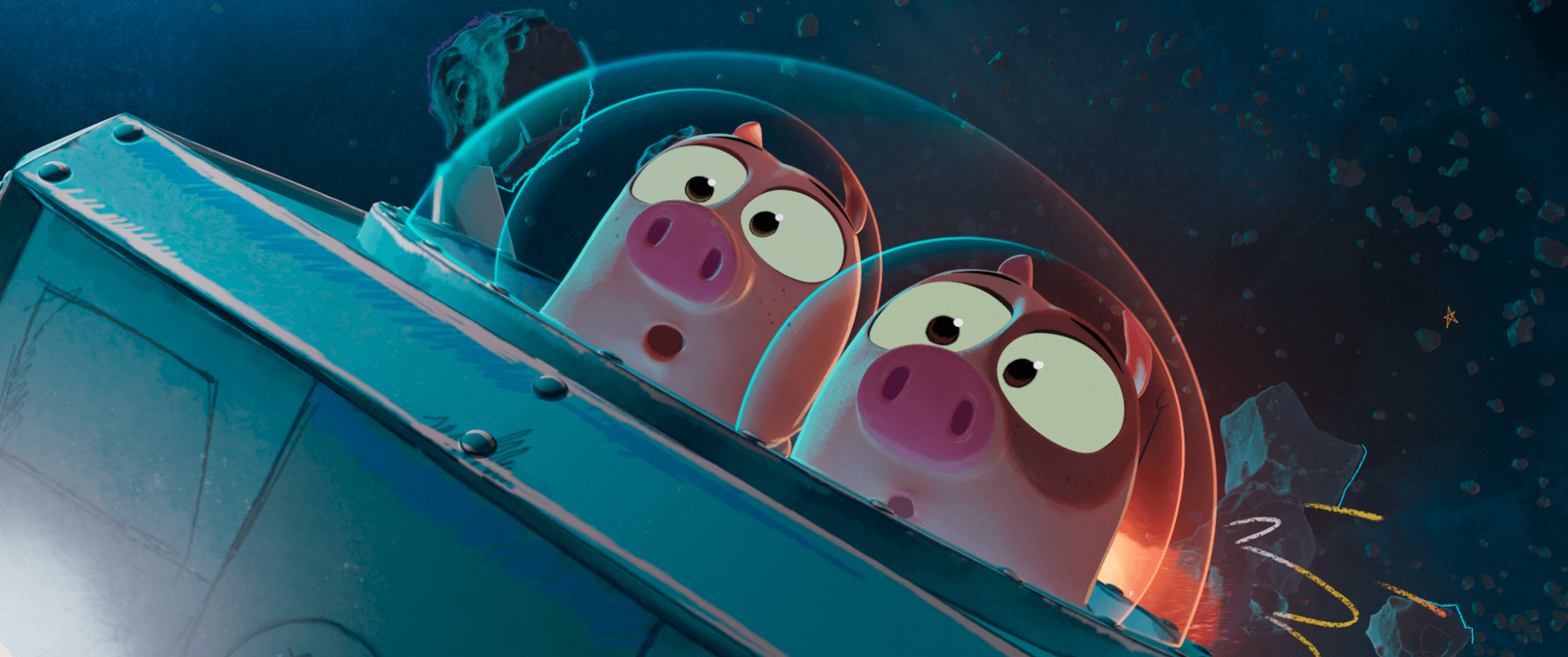
And in the imagination sequences you push the 2D even further, emulating childlike crayon drawings.
Yeah, it was about taking the elements that form the visual recipe of the real world, and then exploding them. That’s where we take watercolor, but for the outer space backdrop, we made it feel splattery like watercolor that’s been dropped in water. What was really helpful was having a visual development painting that just nailed it in one painting and Mike Redmond, who’s a production designer at Locksmith, did a painting of outer space and that captured that childhood naivete in the hand drawn stars but at the same time, there’s a lighting plan that still makes it feel like space, like a distant star. I wanted depth and scale, but still with that playfulness, because the depth and scale is about how big it feels in the kids minds.
How does it feel to have the BAFTA ceremony on the horizon?
I’m really looking forward to celebrating with my team. It’s really rewarding for us to be there, and the other two shorts are outstanding and beautiful. It’s one of those things where you can’t control anything, so it’s about living in the moment, just like the piglets.
The 2026 EE BAFTA Film Awards ceremony takes place on Sunday 22 February.