

Brain Space | Interview with Laura Tofarides

Skwigly and Bristol Animation Meetup (BAM) present the first of a series of articles dedicated to the Bristol animation scene. Hailing from Wales and presently based in Bristol, writer/animator/puppetmaker Laura Tofarides has spent the last decade immersed in the world of stop-motion, contributing to such acclaimed projects as Wallace and Gromit: Vengeance Most Fowl, Shaun the Sheep, Robin Robin, Isle of Dogs, Very Small Creatures, Early Man and Chicken Run: Dawn of the Nugget alongside a wealth of shorts and commercials. The past few years have seen Laura embark on her first directorial effort with the short film Brain Space, produced over a fraught period that spanned pandemics, lockdowns and international relocation.
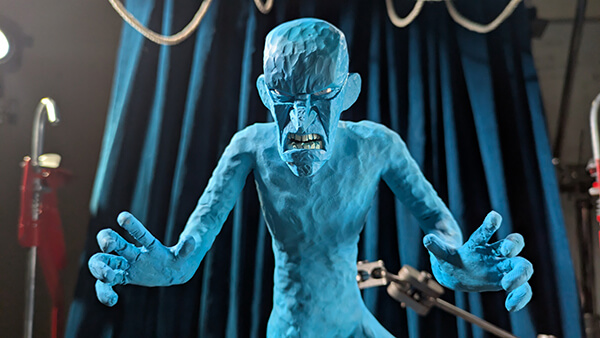
The film portrays the emotional journey of Rhi, a young woman who, in the midst of a house move, is propelled into a tumultuous journey through her own mind and memories. There, finding herself a child again, she confronts a miasma of her internal fears and impulses alongside a masked, theatrical spectre representing an abusive, coercive figure from her past. When fear turns to anger, she fights back to regain control and find a way to heal.
Following its world premiere at the Portland Festival of Cinema, Animation & Technology (PFCAT) in August of last year, Brain Space had its UK premiere at Bristol’s Encounters Film Festival, subsequently screening at national events including Aesthetica Short Film Festival (ASFF) and Manchester Animation Festival (MAF), where it received a Special Jury Mention. With the film longlisted for a 2026 British Short Animation BAFTA nomination earlier this month, Skwigly were excited to speak with director Laura Tofarides about her career in animation and Brain Space‘s incredible, oceans-spanning production journey.
Can you tell us a bit about where you came from and your journey into animation?
I was born and grew up in Wales, but I went to uni in Bristol at UWE. I knew from the start that I really wanted to work at Aardman. I don’t know if it’s still the case but, at the time, Aardman only took interns from a few universities in the UK, and UWE was one of them. So I was very deliberate in choosing my university based on trying to get into Aardman.
I also did a certificate in character animation, which was run through NFTS, but actually ran at Gas Ferry Road. It was very similar to the Aardman Academy courses that run now.
It’s quite a nice initiative to have people really focused in on getting a handle on that specific quality of performance.
It definitely helps, being trained in a house style. But for me, I’d come out of uni and my showreel probably just wasn’t up to scratch in terms of the physicality of animating. I learned a huge amount at university, but not all of it was animation related; you’re also learning how to be an adult, how to not kill your housemates when they use your tea towels to mop up bin juice, all these things. So I knew that, when I graduated, I really needed to do a focused course. It was also my first time ever doing a dedicated 40 hours a week, 9am-6pm, and each week we would get a new task that we would animate. It was just real, focused work with fantastic feedback. That’s how you improve, just real basic stuff, like, how do you do a walk cycle? What are the hips doing? What are the shoulders doing? Where is the weight? And then you move on to performance from there. But you really do need to kind of have that baseline.

Laura Tofarides
What would you say was your first big break into the world of stop-motion?
Chuck Steel: Night of the Trampires was my first job. I started as a runner, because I had never sculpted, so I needed to learn how to sculpt before they would hire me as an animator. It was Josh Flynn who taught me how to sculpt, between all my other runner duties, getting a test unit set up, and begging them to give me little shots to get started. It was off the back of that that I then progressed to assistant, then junior, then full animator by the end of that film, because there were three feature productions happening at the time and animators were like gold dust. That’s partly why I was promoted so quickly, but also I was working really hard.
I imagine there was quite a lot to do.
Oh, a huge amount. It was a very in-depth feature film. It was sculpt-through, plasticine stop motion on singles! Honestly, pretty much every other job has felt easy by comparison. That’s quite nice, because that was a trial by fire. I learned so much on that job, because there were so few of us. There were a lot of new grads, and we were covering a lot of different departments ourselves. But that meant that I learned how to rig, I would sometimes have multiple units on the go, I was really learning that workflow and how to get stuff sorted myself. It’s really stood me in good stead ever since.
Around that time, or nearer the end, Early Man was happening as well. Did you work on that a bit?
Yes, I did three years on Chuck Steel, jumped on and did three months on Early Man, and then three weeks on Isle of Dogs.
That’s a pretty good trifecta!
I think that’s the luck element of career, though. Obviously, you have to work really hard and you have to get good at your job. But I couldn’t have created that scenario, you know. I think success is a combination of hard work, good luck and timing, and I graduated at a good time.
Then at some point, did you go overseas?
New Zealand – we did a year on Kiri & Lou. By that time we were making Brain Space as well, so we moved the entire film there.
Are there any other career highlights in the lead up to Brain Space?
Working on Robin Robin was such an amazing project for me. I’d always wanted to work with Mikey (Please) and Dan (Ojari), because I was a fan of their short films, and so to get to work on this magnificent, stop-motion, needle felt musical was a thrill. It was in 2020 during one of the lockdowns and I remember being on set, so happy to see the crew and to be like, ‘Okay, we’re finding a way to do this’, you know? Just a really, really special project.
Then I think Wallace and Gromit: Vengeance Most Fowl has to be up there as well. I had worked with Nick (Park) and Merlin (Crossingham) on Early Man, but as I say, I was only there for three months, and I didn’t have as much contact with the directors at that time, whereas Wallace and Gromit was part of the reason why I wanted to be a stop-motion animator, so it really was like a dream job. Nick and Merlin were really keen to have lots of feedback from the animators, we had a lot of creative input into our shots, when we were planning them out. It was a really collaborative process and I really loved my time working on that film.
Were there any particular shots on that that you hold aloft?
I have a sequence of the Norbots singing the “handy, nifty Norbots” song – which obviously just lived rent free in my head for about three months – I’ve got a sequence there where Gromit is kind of being unwittingly trapped in the shed by Norbots. He’s in a wheelbarrow, and he’s flipped up on a fence and he’s on a trampoline, and there’s an incredible sequence of getting him into that shed. For me, Gromit is the pinnacle of character animation. I mean, I’m biased, but because he doesn’t speak, and all you have is like the brows and the body language and the timing and the posing to be able to tell the story through. Just a very slight, wry raise of an eyebrow, and the audience knows exactly what is on his mind, and everyone really empathizes with him. So it was always my goal to get some Gromit shots. Obviously, Gromit is Nick’s baby, and it took a little while to kind of get that trust. So yeah, it felt really gratifying to be trusted with those shots.
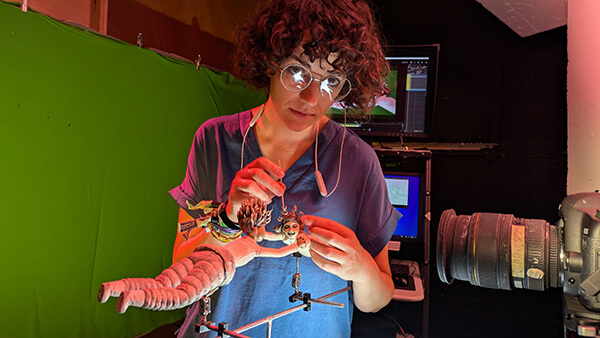
Laura Tofarides
So how long was the idea for Brain Space in the air for?
I’ve been thinking about making this film – or a version of it – for maybe 10 or 15 years, and then obviously the production took five years as well. So yes, a very long, long time.
With what you were saying about luck and circumstance, I imagine that plays quite a bit of a role with getting the right planets to align, to get a film off the ground and get funding and whatnot.
So it was Ffilm Cymru, and some of that money comes from BBC Wales as well. It was the BFI network funding pot, it’s one of their regular funding things that they do. A few people have asked me about the funding, and I don’t really know what the landscape is like out there, because we applied, and we were long listed, and then we were shortlisted, and kept having conversations, and then they said that they would fund us, which was amazing. We did eventually run an Indiegogo campaign just for finishing funds and festival submissions and stuff, but that was last year, right at the end of the production process.
Having secured the funding, do people from that end weigh in at any point with tweaks or suggestions or enhancements, so to speak, of the film, or were you able to stick to your original concept?
So COVID hit, basically, and the BFI network fund at that time was mostly a live-action short film fund, and so they were really reticent to release the funding because they didn’t want to be seen to be encouraging filmmakers to go out and break lockdown -even though we were like, “Hey guys, we’re already in a bubble, we can make this in our bedroom right here!”. But what that meant was that we went through about a year of script revisions, because that’s one thing that you can do. So we had lots of back and forth with Ffilm Cymru. I did find that quite difficult, but also I am really grateful for it, because I am so glad that we didn’t shoot version one. It was a very different film, so actually spending the time on the story was immensely important.
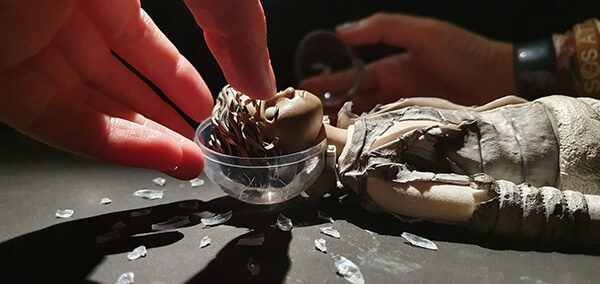
Making Brain Space (Dir. Laura Tofarides)
Are there any fundamental differences you can go into?
It was a lot darker and just not as tight. There was a lot more looking at different parts of her brain, like embarrassment and fear, and tonally it wasn’t as good. Also it kind of leaned more on the very stark, direct, brutal aspects of things; it took me a long time to listen to people and pull back from that, because I thought that they were maybe being a little bit precious and not really wanting to talk about the topic at hand. It took getting some great feedback from directors at Aardman for me to finally listen.
It’s interesting you bring that up because, of course, it is a pretty heavy subject, but it’s told in a way that I think really keeps the viewers’ attention. Aesthetically, it remains quite comfortable and inviting, and audiences can understand what the film is saying without being put in an uncomfortable place. Was there a fine-tuning aspect of it, to get that balance?
I mean, firstly, thank you for saying that. I really appreciate that. Of course, tone plays a huge part of it, but it was important to me that I not have an adversarial relationship with my audience. I’ve been to plenty of festivals and pre-selected enough films to know that, yeah, some people take the tack of almost putting the audience through an ordeal. A really important part of this for me is to connect with an audience, so I was trying to think, “How do I do that?” You need to build up the empathy with the characters before you then put them in peril, and it was important to me to get them into the story really quickly, into the theatre of the mind, and to keep the audience on side. It’s been amazing in the screenings that I’ve attended that people come up to me afterwards and say that they really empathize with the characters, and they had a strong emotional reaction to it. And I think that’s amazing. That’s what we want, right? As filmmakers, we want to connect with people and to move people.
For the puppet making, you worked with Sculpt Double – or was it just Josh?
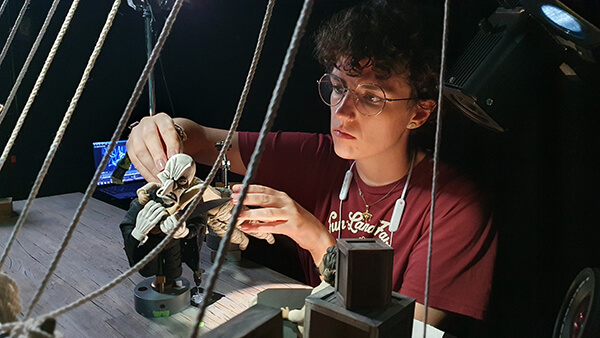
It was predominantly Josh. I think Nathan (Flynn) did make one of the armatures, but it was mostly Josh, who only signed up to make the puppets and ended up animating most of the film because I was busy animating on things like Wallace and Gromit and Kiri & Lou, but luckily, he’s a good animator as well.
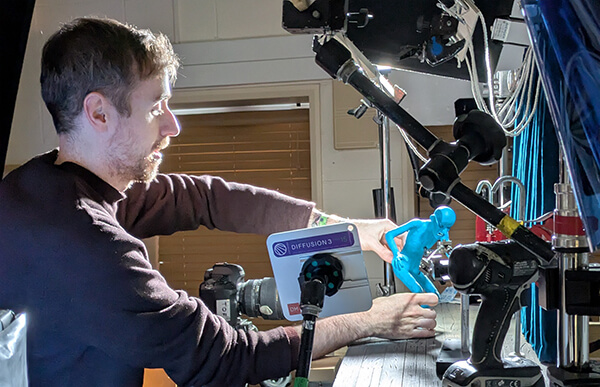
Joshua Flynn
Could you tell us a little bit about what they do, and your relationship with them over the years?
So I met Josh and Nathan on Chuck Steel, they were two of the main sculptors on that film. Josh is my boyfriend as well, he taught me how to sculpt and a lot of puppet making stuff. They work on a lot of high-end features, they did some of the main sculptures for the faces on Isle of Dogs and sculpted some of the dogs, and kind of informed the characters Atari and Tracy. They also worked on The Grand Budapest Hotel and Frankenweenie and all kinds of stuff, Robin Robin, Love Death + Robots, the Over the Garden Wall 10 year anniversary special, as well as a whole bunch of commercials. So they’re incredibly talented, and obviously having Josh on board, he gave up years of his life animating, mostly for free, to help me make this. I asked him “Why?” and he just said “Because I want to help you to make this film to fulfil your vision”.
But I think he also got a lot of creative satisfaction out of it, because he designed the puppets, he made all of the replacement faces – they’re all handmade, there’s no 3D printing. That’s a technique taken over from Isle of Dogs, because Wes Anderson loves everything to be real and in-camera and not using computers as much as possible. He also got to set up the cameras and the lights and to animate it all mostly himself. So, yeah, I think he got a lot more creative satisfaction out of the shooting than I did. Quite frankly, I found the shoot a really frustrating process because, for the most part, I wasn’t present, and trying to do everything through someone else I found quite difficult. I would never advocate for trying to make a short film at the same time as working full time. It was too much. But when I started, I didn’t have a job, and I kind of thought, I’ll make my own short film. I’ll hire myself as an animator. And then everything got busy, as they do.
And you mentioned having to bring it overseas, did you have to bring it back again? Or was it finished when you were over there?
Oh no, we had to bring it back here. So, in the time we made this film, I worked on two feature films, four series, one half-hour short and a bunch of commercials. And, yeah, we moved it to New Zealand and back, and we shot in four different studios. Everything about it is crazy, and it’s been really a hell of a journey. I am quite thankful it’s finished!
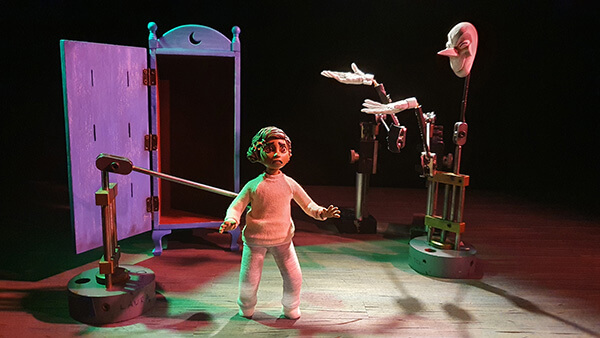
Making Brain Space (Dir. Laura Tofarides)
Thinking of the design for the villain character, the concept, visually, with the mask and everything was really nicely done. I was sort of wondering if there were any kind of specific sort of cultural roots in the depiction of the character?
We’d been watching Sichuan opera online, and they do this amazing thing where they put the arm in front of the face, and then there’s a mechanism in the head that changes the mask to show changing emotions. We thought that was really cool. But with his overall design, there’s not that many masks, maybe, like, seven or eight, so we’ve got no in-betweens. We wanted to make them really visually distinct and really see how far we can push them. Obviously, he starts out quite neutral-looking, and then gets freakier and scarier. But the whole idea behind them is that he’s obviously a bad guy, and it is a big old visual metaphor for coercive control and people being manipulated. He has a very mercurial personality, you don’t know where you stand with him. Who is the man behind the mask? We don’t know if we only see what he shows us. And so, when he is then finally unmasked, and he’s hiding in the glare of the light of truth, that’s when we see him, and he doesn’t like that at all.
As well as Josh, pretty much everyone in the credits was someone who felt like a real get. I was wondering to what extent were you able to assemble an ideal crew? Or was that a decision that was in someone else’s hands?
The crew was up to me, I would say. I mean, we had a very, very small budget, so actually, the credits make it seem as though there are a lot more people working on the film than there actually were. For the most part, it was just me, Josh, Nia (Alavezos, producer), and Zuhair (Mehrali, VFX and editor), and then all the other people there came in for like a week or two as a favour for us. I think that’s the benefit of having worked in the industry and having those connections, is that I can ask the best people in the industry, and sometimes if they’re not busy – or even if they are – people really like a creative challenge, their motivations for doing things aren’t solely monetary a lot of the time. A lot of people who worked on it just thought it was a really cool concept, and they just genuinely wanted to help us. And I’m so grateful to all of them, because we could not have done it by ourselves.
Making Brain Space (Dir. Laura Tofarides)
It’s a lovely thing, and I’ve seen it a few times in Bristol. There’s something about the local community where people do want to band together a bit.
The Bristol creative community is amazing. It’s part of the reason I love living here is that you’re surrounded by amazing, talented artists.
And it was very nice to be able to give it its UK premiere in Bristol at Encounters. How has the festival response in general been?
Yeah, Encounters was the best place for our UK premiere. It was great. Generally, we’ve had a really good time at festivals. Our world premiere was at the Portland Festival of Cinema, Animation and Technology in Oregon, so the benefit for us was that we also got to meet a lot of the animators who worked at ShadowMachine and Laika. And I managed to get a tour of Laika, which was a bucket list tick for me! We’ve also taken it to the Bucheon International Animation Festival in South Korea. We only got to spend four days there, which I feel is crazy, because I had to get back to my job and carry on animating, but it was a pretty magical four days.
Laura Tofarides
And BAFTA contention has to be exciting. Do you have anything kind of special planned for it in the lead up?
The BAFTA longlisting really genuinely took us by surprise. I was immediately elated. And then just like, “Oh no, I’m really on the back foot here. I should have planned for this!” One of the producers on Chuck Steel once said, “Laura, you need to learn to plan for success” – there’s wisdom in there! We’re having lots of chats with lovely people such as yourself, I think we’re screening it at a couple studios. I just had a screening today, actually, here at Aardman Aztec West, with all the Shaun the Sheep crew. I think we’re also screening at Blue Zoo quite soon, and the Women In Animation online event. Just showing the film to people and seeing what they think.
We’re doing a talk at Animatex in February in Egypt, so I’m really excited to go to that. That’ll be in Cairo. I’ve heard lots of good things about it, plus I’ve never seen the pyramids, so that’ll be great! There’s also been a few people actually inviting us to festivals in the past few days. So that’s a new thing for me, it’s very exciting. But who knows what the future holds?
For more on Brain Space visit the film’s Instagram and lauratofarides.co.uk
Bristol Animation Meetup is an initiative of Skwigly Online Animation Magazine, Rumpus Animation and Sun & Moon Studios. For updates follow us on Instagram.