

The Art of Writing Animation Book Review: A Rare Look at How Animation Stories Are Developed & Written

I have always found writing for animation to be one of the least talked-about areas of animation production. While there are many books that explore the production process, visual development, character design and history, I can count on one hand the number (that I am aware of) that focus on writing the story in the first place.
That makes The Art of Writing Animation: Storytelling Craft for Writers & Animators by Alizée Musson a very welcome addition. It has been almost twenty years since I last picked up a book dedicated to this subject, so I was full of curiosity when the book landed on my doorstep.
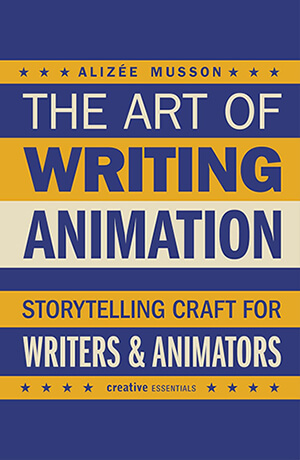
The Art of Writing Animation: Storytelling Craft for Writers & Animators by Alizée Musson
Musson is a London-based writer and development consultant, and she states the purpose of the book early on: “Rather than giving you a formula on how to write for animation, my aim with this book is to take you behind the scenes – to show how animation filmmakers approach development across different styles and cultures.” So, rather than trying to teach you how to write a script, or explain the three-act structure and such, this book focuses on showing how writing actually happens, and the processes that have been followed during existing productions.
One of the things that stood out to me was how current and varied the examples were. There are a healthy mix of US, UK, European, and international productions, covering everything from blockbuster features to viral web series. Covering the last 20 years or so, the book uses more than 25 case studies and interviews, and pulls together insights from writers, directors, producers, and story artists who have worked across indie shorts, TV series, web content, and features. These insights give a snapshot of how animation writing has evolved up to the present day.
The book is neatly divided into six chapters, starting with the fundamentals: (1) what animation is and how it differs from live-action, (2) how to write characters and how their development drives story structure; before branching out into more specific formats: short films (3), feature films (4), web series (5), and TV series (6).
I loved this structure as it allows the reader to dip into the areas most relevant to them. I skipped to the TV and web series chapter, as I am more familiar with these formats, before jumping back to the earlier chapters. Each section stands on its own.
All chapters are broken up into digestible and engaging chunks. Interviews, case studies, and practical sections alternate every few pages, so the book never feels dry or heavy. Each chapter concludes with ‘Story Editor’s Corner’ – a set of recap questions to apply to your own work – alongside a list of film and book references.
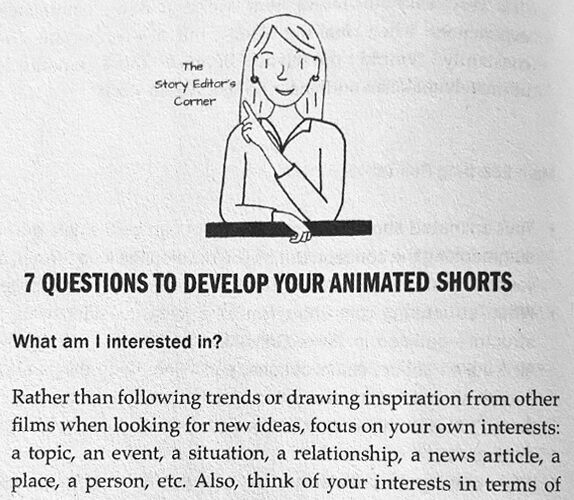
Story Editor’s Corner snippet
A few highlights from these chapters
The TV series chapter offers a great look at the realities of series writing, from explaining the role of a showrunner and writer’s room, to how consistency is maintained across episodes. There are some interesting case studies here, particularly around preschool TV, including how Peppa Pig was developed and pitched at Cartoon Forum (they started with 52 short outlines for each episode idea; then 13 longer synopses and 6 full scripts). It also highlights the practical constraints of producing a first series, such as having limited backgrounds and assets, and how these can shape storytelling in ways you would not consider.
The feature film chapter touches upon how stories evolve through a high level of collaboration and feedback, with the example of Encanto and how certain cultural feedback resulted in the whole structure having to change.
The short film and web series chapters felt particularly fresh and up-to-date with the film examples they used. Web series are a format that have not been spoken about a great deal in animation books, especially to do with the craft of writing, so this was great to see. The chapter looked at how they follow a different set of rules to traditional TV series, and I really enjoyed the breakdown of Simon’s Cat Let Me In as a case study that explored this.
Overall, The Art of Writing Animation is a very insightful and unique addition to the small pool of books on this subject. It does not teach you how to write scripts in a step-by-step way, and you will not find full script examples here. If that is what you are looking for, this probably is not the book for you.
For students, emerging writers, or anyone looking to move into animation, what it is does offer is a wealth of real-world experience to learn from. Even if you are already working in the industry, there is plenty to inspire you. What this book has taught me is that there is no fixed approach to writing for animation; rather, it is a collection of approaches that are influenced by format, budget, culture and circumstances.
As Musson states: “Work those story muscles by watching as many animated films and series as possible.” And on that note, I am off to do exactly that!
We may earn a commission if you buy through these links.