


Happy Birthday, Blue! The 30th Anniversary of Nickelodeon’s Blue’s Clues

On the 8th of September in 1996, Nickelodeon’s dedicated preschool channel, Nick. Jr, would be changed forever when a blue puppy named Blue came bouncing along the screens with her charismatic and energetic owner, Steve (played by Steve Burns). Helping to solve mysteries around their house, Blue would lead Steve (or Kevin for the UK version of the show) on a journey across their colourful home with clues that he must solve with the help of the young audience at home.
Before Bluey took over as the top blue dog of preschool television, Blue had dominated households through a show that had not been seen at the time, which only saw Nick Jr eventually grow and be able to stand equally tall among the animated hits and comedies that made Nickelodeon a household name. Leading the way to educational as well as entertaining multiple seasons, what made it such a hit for preschoolers around the world in the 1990s and early 2000s? And who was responsible for cementing its success? We’ll just have to follow the clues to find out.
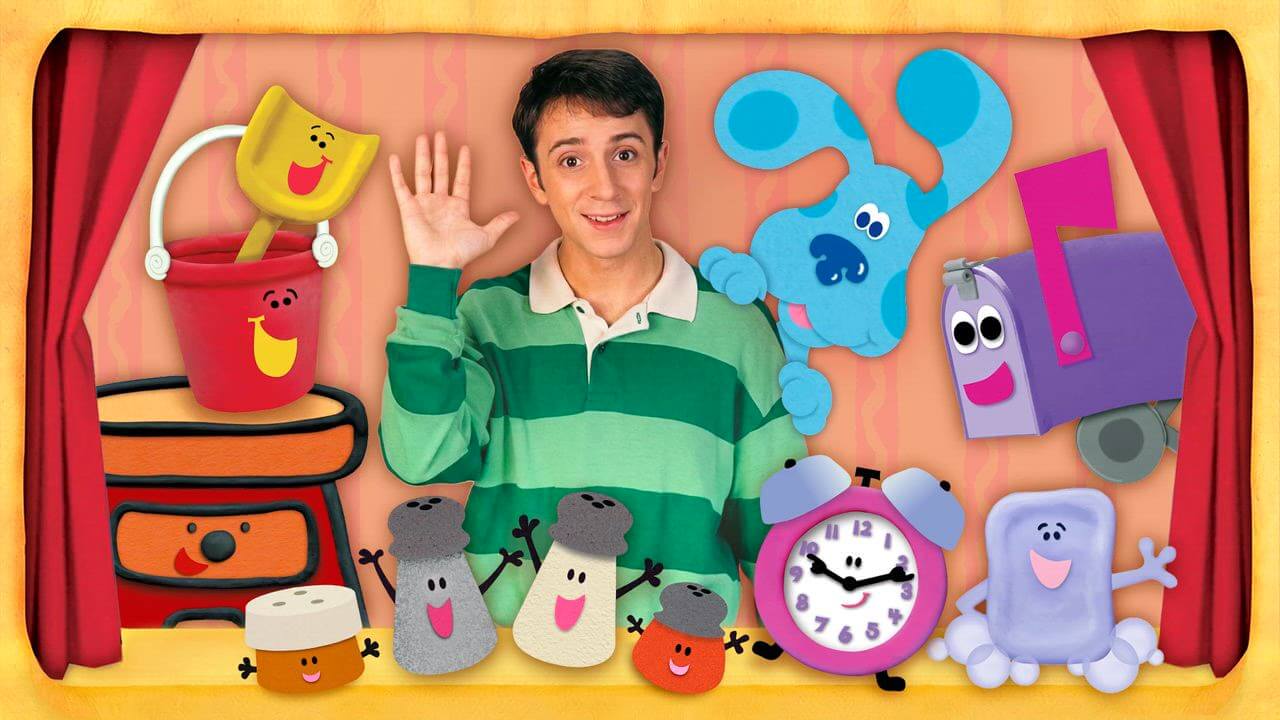
Steve with Blue and the characters of their house. Image sourced from IMDb.
In the summer of 1994, the executives at Nickelodeon decided to hire fresh, young talent to initially create a game show for their preschool audience on a small budget, with three people eventually hired to take on this task. They were Angela Santomero, a researcher who worked for Nickelodeon since the early 90s, Todd Kessler, a freelance producer for the network, and Traci Paige Johnson, who was a freelance animator at the time. Despite their different levels of experience as well as career paths within children’s television, the three would spend approximately thirty days in a conference room above Times Square in New York, US. It was in this space that they developed the initial idea for the show, combining their production and research skills in an attempt to make something that can be as educational as it is entertaining.
A research department was made specifically for the show, and while they already had a talented researcher under the creative leading trio, Alice Wilder was hired as the Director of Research and Development. One of the reasons a department for research was created was because of how they would approach and develop each script after the pilot gave them the green light to produce a season. As well as carefully selecting props and items that children could instantly recognise in their own homes, they also visited schools to receive feedback and reactions from children on the scripts that were being developed and episodes being produced and edited.
As for the design and animation choice that led to the simple yet colourful and charming aesthetic, that responsibility fell upon the shoulders of Dave Palmer, who was initially picked to design Blue. Using circles and rounded shapes for the character’s frame of body, he was able to make a very cute and approachable design that would play a key part in how the character would appeal and speak directly to the audience. His keen eye and talent led him to become the supervising director of the animation and animation producer for the show, helping to build the animated world that hosts would interact with via green screen.

Angela Santomero and Traci Paige Johnson. Imaged sourced from JaMonkey.
With the combined efforts of all those involved, Blue’s Clues‘ first episode finally aired on Nick Jr on the 8th of September 1996. And despite the low budget and their unique approach at the time when it came to research, it proved to be a hit among children and families across the US, earning approximately 13 million views for the episodes that would follow. The character’s popularity grew as more and more people became aware of this little puppy and her curious nature, paving the way for multiple exports that featured different hosts in those countries (including the UK with Kevin) and merchandising everywhere.
But while the show proved to be popular among households, it also had a major impact on those researching and studying trends of screentime and the positive and negative impacts on children’s behaviours. While the show may not have quite ended up being the game show format that the executives at Nickelodeon were expecting, the interactive parts, as well as research on cognitive behaviours and potential participation with children, and the feedback from classrooms for scripts and episodes, made it something so much more than anyone could have imagined. This simple approach proved to be effective, with universities such as The University of Alabama and Vanderbilt University researching the structure of the show, discovering that it showed children increasing their learning and social skills when they watched and interacted with it. This not only made it stand out at the time in children’s television and broadcasting, but also saw Nickelodeon continue to push what was possible for education and entertainment to follow, with shows like Dora the Explorer and The Backyardigans continuing to prove how powerful television could be for a child’s development.
The show eventually wrapped up in 2006 with 143 episodes across six seasons, and despite the strong viewership and global fanbase, the series eventually stopped production, and Nickelodeon relied on repeated broadcasts of previous episodes. And while Steve’s replacement, Donovan Patton as Joe, did his best in 2002 to carry on the work that Steve set up, he just wasn’t quite the same as the original actor who helped to cement the show’s early popularity.
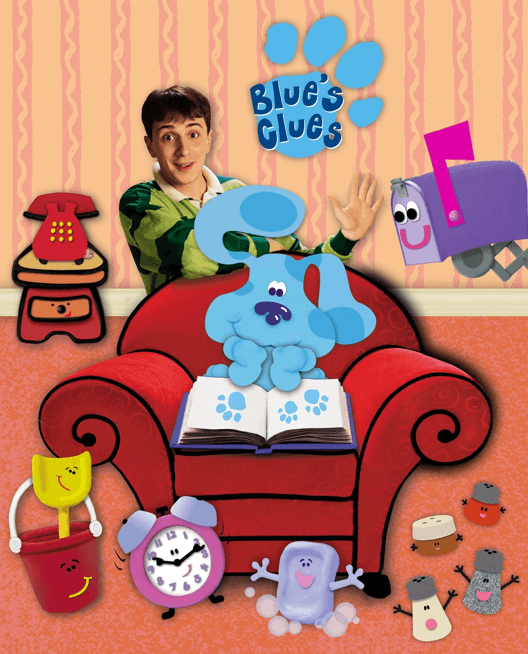
Blues Clues characters poster
Thirteen years after the last Blue’s Clues episode aired on Nick Jr, both Traci Paige Johnson and Angela Santomero decided to revive the character and the series for a new generation of audiences that would both air on Nickelodeon as well as be available to stream on Paramount+. Blues Clues and You! followed a similar structure to the original series, with new host Josh replacing the previous ones to help Blue search for clues around the home. And with digital technology now more readily available, the series still had its familiar design and narrative structure even older fans could recognise, but using digital animation, the show could shine when it came to its design and aesthetic. The success even saw a film being released exclusively on Paramount+ named Blue’s Big City Adventure that received lots of critical praise.
The revival proved to be a hit with modern audiences as the series ran for five seasons, although the fifth season was cancelled after only four episodes had been produced. Despite no information on why the show was cancelled, it did earn a Children’s & Family Emmy Award last year for Outstanding Preschool Series, and while there isn’t any news to bring the iconic blue puppy back, it did see new fans being created as well as returning ones as parents reliving their childhood classic.
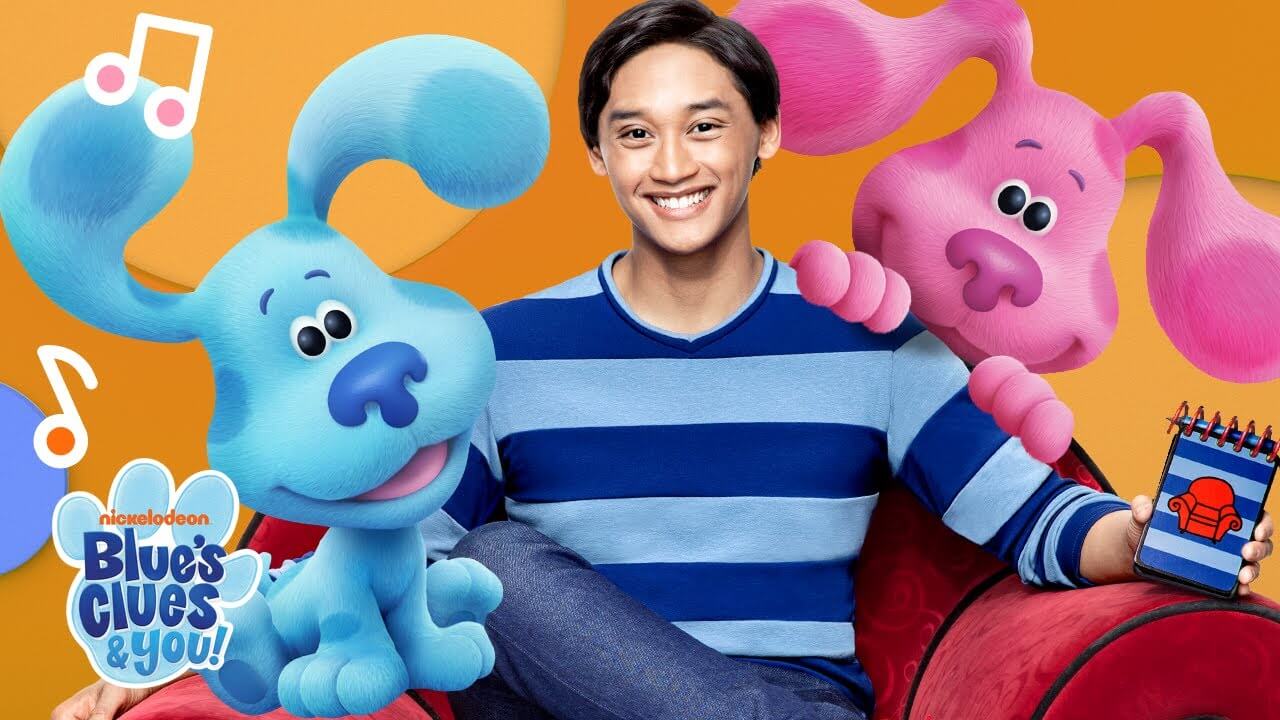
Blue, Josh, and Magenta. Image sourced from YouTube.
Blue’s Clues‘ legacy in children’s media can’t be overstated, as it helped to cement the dedication, craft, and impact that it had on two generations of viewers and how it’s simple yet effective methods of mixing education impacted not just positive television experiences, but research and television’s impact on children too. Blue may be in the doghouse as of writing this, but her inquisitive nature and her creators should be honoured that they created an icon who paved the way for preschool television that hadn’t been seen for some time.
Blue’s Clues and You! and Blue’s Big City Adventure are both available to stream on Paramount+. The original Blue’s Clues series is available to purchase on Amazon Prime UK.