

Daniel Chong and Nicole Grindle on Pixar’s Most Rebellious Film Yet, Hoppers

© Disney Pixar
Hoppers is as rebellious as Pixar have ever felt. Within the framework of a cute talking animal movie, director Daniel Chong crafts a story about governmental and corporate distrust, young adult activism, human-led environmental collapse and flying sharks. We follow Mabel, a 19-year-old who uses an Avatar-like technology that allows her to inhabit the body of a mechanical beaver, a great aid on her mission to save the glade that she grew up loving, as the mayor of her town, Jerry, looks to build a highway over it.
Distinctly carrying Chong’s voice as much as it sits comfortably within the Pixar library, Hoppers isn’t afraid to be erratic with its jokes and risky with the images it throws on screen, just as its fearless protagonist isn’t afraid to take on authority in both the human and animal kingdoms. Chong, helming his first feature film after manning the Cartoon Network series We Bare Bears, is one of the freshest voices brought to the studio in years.
Skwigly caught up with Chong and as well as producer Nicole Grindle to chat about crafting Mabel’s character, choosing not to over-stylise nature and their reactions to Disney’s investment in OpenAI. You’d be hopping mad not to read on.
I want to start off by talking about Mabel as a character. Why was it important for her to be college-aged?
Chong: I think we talked a lot about Mabel being a person that would exist today and a person that would be dealing with the things that someone today would be dealing with. They would be someone who is thinking a lot about their future and the world that they’re going into, they would certainly be someone about Mabel’s age who is becoming an adult and is looking at their future and going, ‘Do I have one?’ and asking, ‘How can I change the world and make it a better place?’
I love that she’s not an everyman, that she’s slightly annoying but has her heart in the right place. How do you know when to soften her and when to make her personality more spiky?
Chong: I love that question because the main character sometimes can be the most uninteresting person in the movie and I think that is because they need to be so grounded, and they need to represent everyone. We had a desire to take a bold swing with Mabel, and we wanted her to be the most unpredictable character in the movie. We definitely paid the price for that, though, because getting to make this fun character who was chaotic and unhinged and would do anything and jump into fire, it was hard to ground that character. It’s hard to make her somebody that everyone could emotionally relate to.
Grindle: That was the biggest challenge we faced all along, doing test screenings and making Mabel more compelling and sympathetic. People would say, ‘I love the movie. It’s hilarious. I love all these characters. Mabel, not so enthusiastic,’ and that was surprising to us. That’s how we came up with the opening sequence where she’s a child with her grandmother. Seeing a young person at 19 being angry was off putting, but seeing a little girl who wants to save animals and you know she doesn’t know the right way to do it and be persuasive, that was sympathetic. It helps to see her wonderful grandmother who gets her and loves her and knows how to ground her. Suddenly, people had a way in, and so that when she was 19 and she was yelling and angry, you knew who she was on the inside, you knew her intentions were good and that really turned things around for us. We were able to get audiences behind her.
Could you talk about crafting her design?
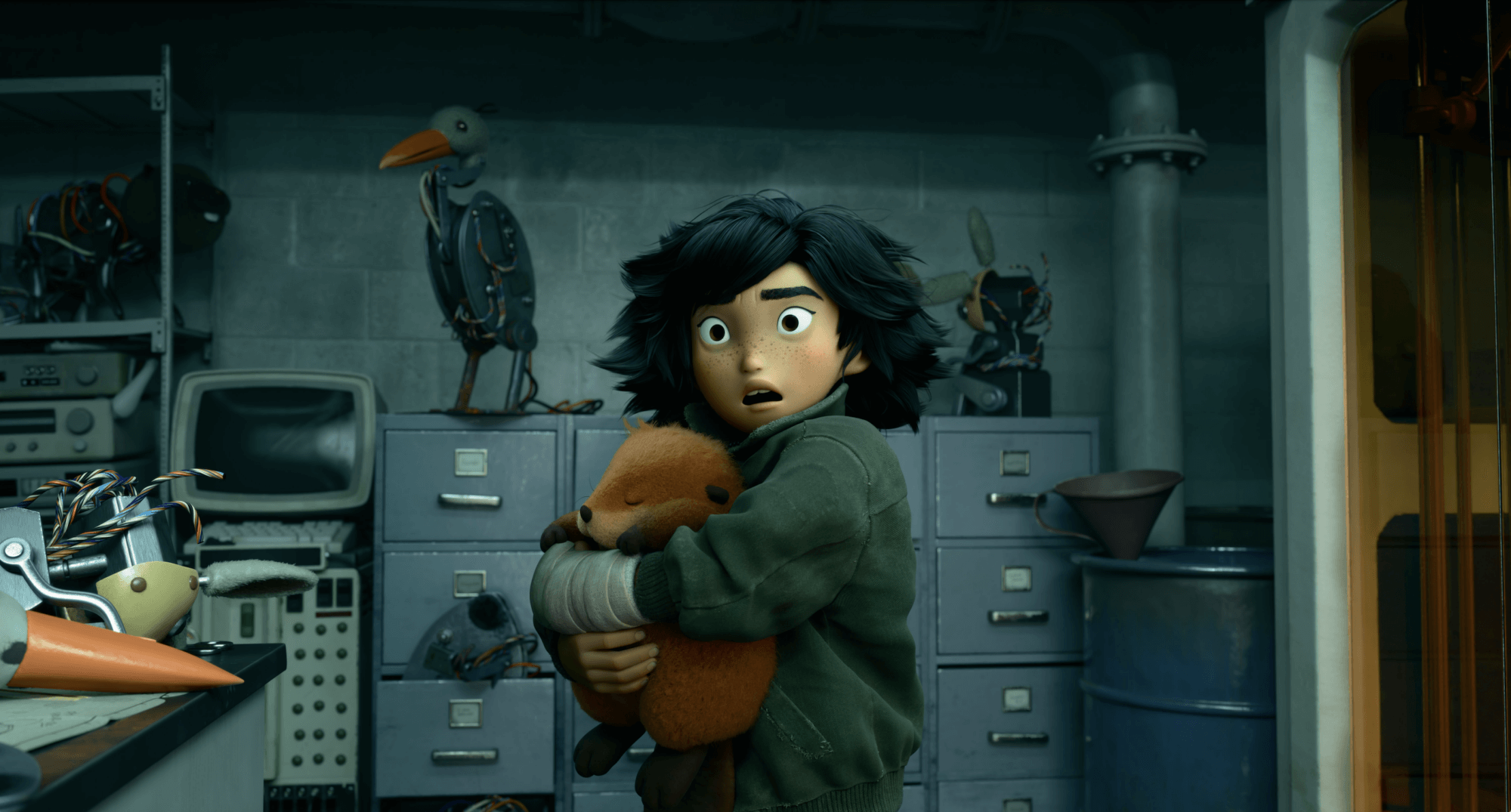
Chong: We wanted her to feel wild-looking because she’s kind of feral. She’s a person of nature. She loves animals more than people, and she is a person who wouldn’t care what she looks like. So her hair is all over the place. She broke her arm, she doesn’t care. She’s wearing different coloured socks, doesn’t matter. There’s all these scrappy things about her. All those things were character choices, in terms of how to portray this character who was more in the animal world than she was in the human world.
© Disney Pixar
Grindle: What I love, too, is that the design translates from human Mabel to beaver Mabel. When she gets really upset as a beaver, her fur would flare out, just like her hair does. At first, we weren’t sure how that was going to translate, but I think you completely track her character, not just because of the voice performance, but there is something about the energy of her physical performance that denotes Mabel. Her emotions are so big, and to see that in a little beaver, particularly in contrast to Loaf and to King George, I think we were able to nail that continuity between the two versions.
The depiction of nature in the film is pretty photoreal, was there ever a temptation to stylise it more?
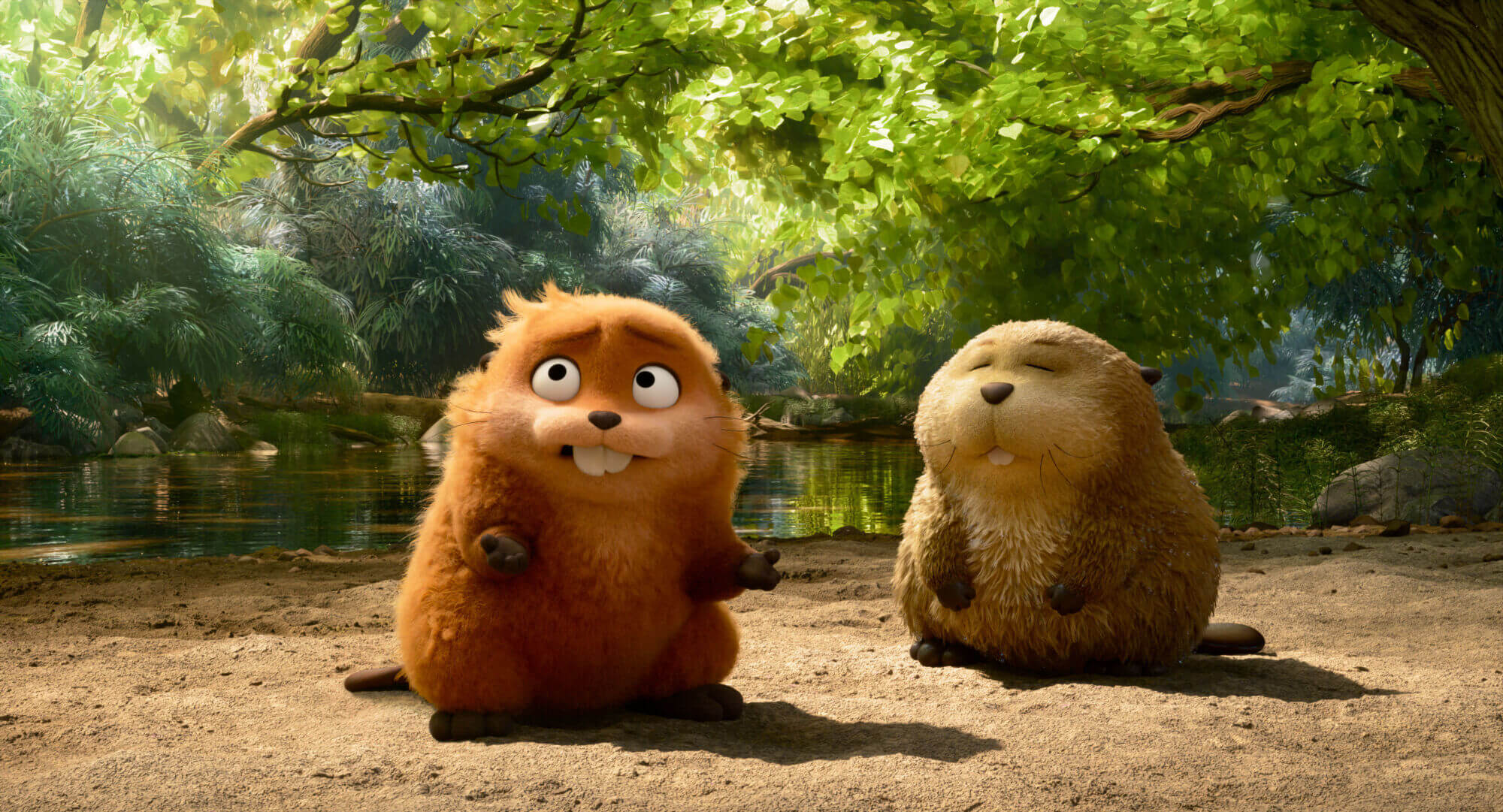
Chong: We definitely took swings to stylise the movie more and to make it look very different. But when it came down to it, part of the thing with nature is wanting to relate it to what people would know. We also had to figure out ways to stylise nature to some degree, because it needed to fit in with the animal designs. These are really cartoony looking characters, and they need to fit into that natural world. If they were just in a photo realistic background, it would look weird. So here’s the challenge, how do you stylize nature, make it feel real enough, but also make it look caricatured so it fits those cartoon designs?
Grindle: We actually developed a tool on this movie called the paint brush tool, where each lighter did paint brush strokes on paper, and then translated that into the computer, and could paint that on and tune it to each shot. It’s mostly in the nature shots, but they could even do it in some of the human world shots. And future movies actually want to use this tool, because this wonderful way to direct your eye to the character or whatever you want them looking at, but also not to lose any of the color.
There’s lots of creative work done with the character models in Hoppers, both with switching out the animal eyes for bigger eyes and really pushing their expressions to their limits. How difficult is it to do that stuff?
Chong: It’s very difficult, and I think a lot of it starts in the story phase. We just went zany with a lot of the acting and with the craziness, to an extent. There’s still physics and rules involved, even though we do go a little wild. But I think finding the balance between broad comedy, but also grounding it enough so you believe that the stakes are real, that they could die, it’s a balancing act. It’s just a handshake between everyone, especially once it gets into animation because that’s where they can really go wild. Storyboarding is just a blueprint, but animation, that’s gonna be on screen. So it’s a conversation with all the animators as they’re doing it. We go, ‘that’s too much, you need to push a little bit more this way, that’s not quite our style,’ you’re just constantly pushing and pulling levers to calibrate the sweet spot. The animators, to begin with, veered on just being a little more pushed and it was always easier to rein back. We took six years to make this movie, so we had time to play around with that. I can only chalk it up to a lot of really talented people.
© Disney Pixar
What was the most stressful scene in the movie to achieve?
Grindle: As producers, kind of the whole thing. The film genuinely was enormous, 35 different body types, nothing like that has been done at Pixar before. All of that was challenging. Is there a particular scene? I mean, at the end of the movie, there’s some big effects shots that were really, really hard. Actually, we had to make some changes after we had locked in some things to make it work. There’s a whole scene with a lot of water, and that the way that water moved had to be changed after someone had spent weeks and weeks working on it.
Chong: I’ll talk a little bit about the council scene with all the animals. The challenge there is, it’s basically like a play. Everyone’s in one locked place, and it becomes just about pure acting and there’s not a lot of movement. For our layout team, it’s very hard to shoot that, because eye lines get messed up all the time. When it comes to the animators, it’s really hard to reel in the acting in the right way, because the scene goes from being goofy to serious. We actually had a very small team, because a lot of the team went off to go work on Elio at the time, but we had like 10 or 11 people left, and they all focused on that council scene. It was a beautiful thing to see, but it was also very challenging for everybody.
Was it a challenge to bridge your Cartoon Network sensibility with the Pixar one?
Chong: From my point of view, it felt pretty seamless. I know maybe from Nicole’s standpoint, there was a little more pushback, but I felt like I was being very intuitive. Maybe part of it is because I came from Pixar before Cartoon Network, I’d been working there for years, and at Disney, so a lot of my DNA does traditionally come from this place. When I went to Cartoon Network, it was more about finding my voice and what I specifically like. But I always knew how to build these features, having seen them being built because I worked on them. It felt pretty seamless to me, but maybe the truth of it is I did scratch some heads at the beginning.
Grindle: That’s more about Daniel’s voice than Cartoon Network, and it’s ultimately what makes the film feel so fresh. He’s got the Pixar brand elements, he’s got the humor, he’s got the heart, but also he has a sense of humor that’s a bit unhinged. Pixar is all about setting up the rules of their world and sticking to them, but Daniel likes to set up these rules and then knock them down and I think at first that was startling to some people. Though, I have to say, Pete Doctor and Andrew Stanton were always 100% behind it. But you’d get notes and screenings from other people who are like, ‘I don’t know about that.’ It took a while to push through on that and get everybody in the studio on board, and then we did turn a corner.
© Disney Pixar
I can’t picture many other Pixar movies having something like the shark scene…
Grindle: The shark situation was particularly jarring.
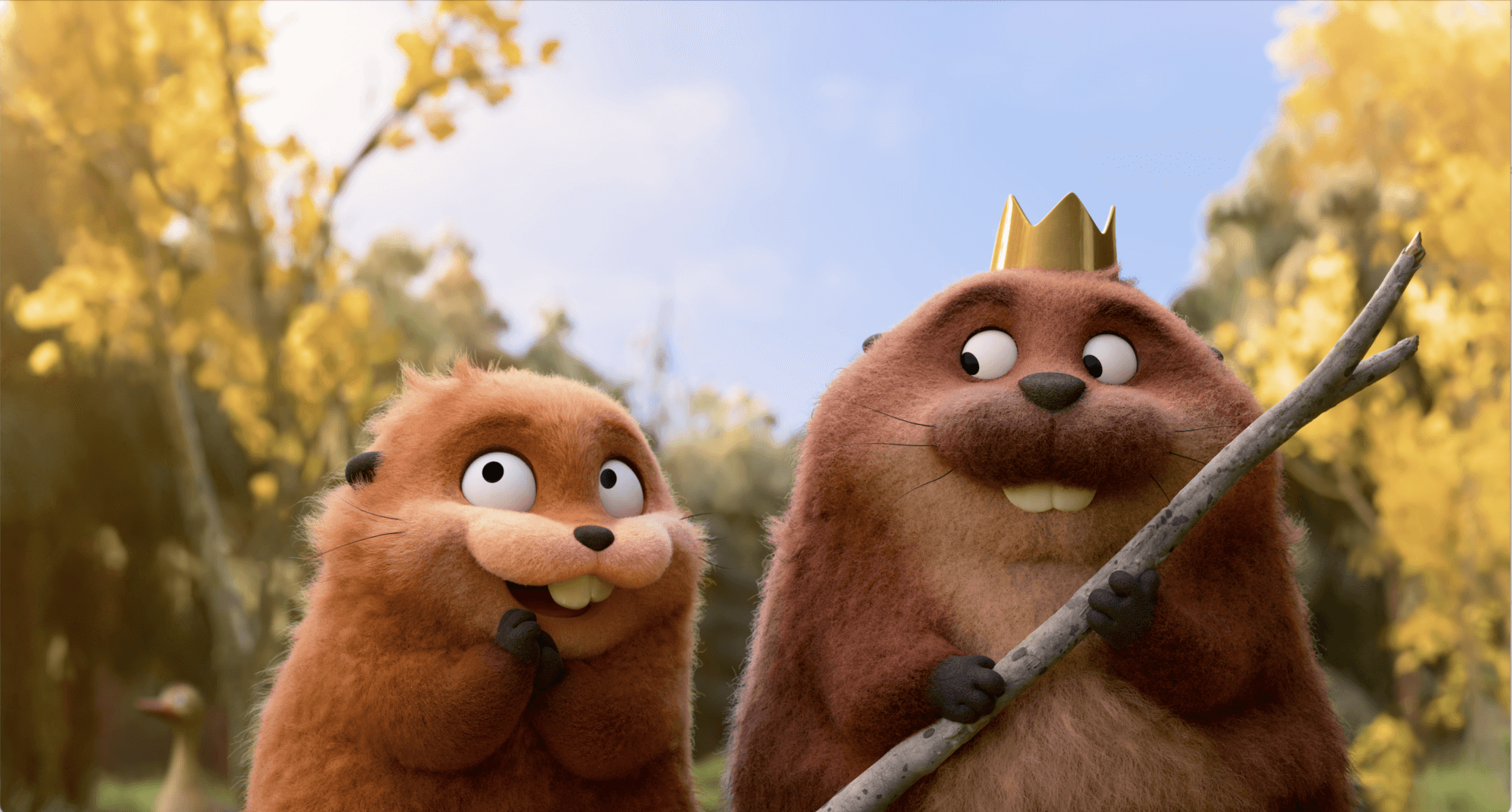
Chong: We definitely got a lot of notes. When we were building this movie, we knew that every step of the movie was trying to see how far the audience would go with us. Do you accept that these animals can wear crowns? Okay. Do you accept that there are other animals that were crowns? Okay. And then do you accept the shark? You’re just pushing them towards this edge. And certainly, in early versions, we pushed way too far, and we had to reel back, but the movie still got to stay crazy because we built the parameters very clearly, and just slowly eased people into the tone of the movie, to the point that they’re believing some crazy stuff at the end of it.
A few months ago, Disney signed a big deal with OpenAI, how did you both react to that news?
Chong: We didn’t really know how to think of it when we heard it. It’s impossible not to feel troubled by it, of course. For me, making a film this big, it required so many people and I saw them put their humanity into it, and I saw how that made it have a soul, It gave it life, and it made it feel like something authentic. I just don’t know how [AI] could replace the process, because [humanity] is what was required.
Grindle: I think it made sense. Disney wants to be on the ground floor and there’s no better way than to do this partnership. It seems like it’s a way for fan art so people can engage with our characters in a way they already do. People draw all kinds of things, so this is the next step, and you might as well own the way that they’re doing it. So that made sense. How that will affect us as filmmakers, I don’t know. I can’t understand how that will connect to what we do. But who knows? It’s a crazy world we’re in right now.