


Iron Boy Review: Louis Clichy Creates a World “Indistinguishable from a Memory”

© Sony Pictures Classics
I wanted Iron Boy to draw me closer. Seeing myself in so much of main character Christophe’s story, I felt primed for the film to sweep me away, have me walk every step alongside him and be a puddle of tears by the ending. While I found myself charmed by a lot of what director Louis Clichy conjured on screen, I felt at a remove from the full emotion I was expected to feel.
Iron Boy is Clichy’s first original feature after spending a few years directing a couple Asterix and Obelix features which came in the wake of a stint at Pixar where he worked as an animator on Wall-E and Up. All of that experience is put on screen through Iron Boy , a film with a clean, tender narrative realised in a gorgeous art style.
We follow Christophe, a pre-teen growing up on a farm who is visibly at a remove from his agriculture-first father and older brother. This chasm is widened when a structural problem is discovered in Christophe’s spine, requiring him to wear a steel brace until it’s corrected. Additionally, the financial situation of the farm and Christophe’s inability to help only serves to make the boy’s vital years of development even more strained and confusing.
There are a few moments early on in the film where Christophe is trusted with tasks like posing for his school photograph and helping his dad on the tractor. Both end in slapstick calamity all because of a disability Christophe doesn’t even know he has. Reader, I have been that child, and I felt so close to Christophe’s confusion and confused self image.
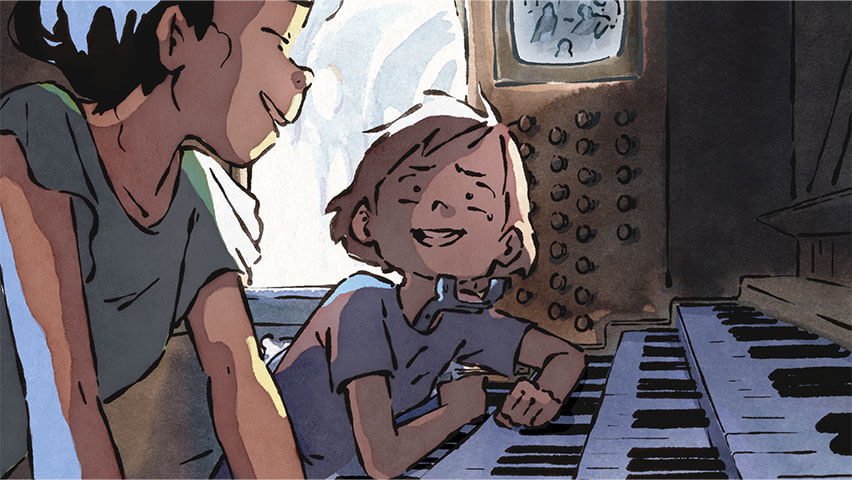
Throughout its runtime, Iron Boy hits you with a handful of moments that hit so true, they feel like they could have happened in your own life. As the pressures of this disability and his family’s financial situation, two things he has no control over, close in on him, Christophe finds a couple things to channel his energy into. One is the church organ and the other is his first crush, Clara. Both the instrument and the friend allow him to feel moments of weightlessness, depicted by him literally floating above the earth, as he finds those small pockets of time where you can actually let go.
© Sony Pictures Classics
Christophe also finds a way to enjoy his musical hobby and help out on the farm by working out adjustments for his disability. The film, for its majority, is a great representation of how people in your life, and the world at large, can and should change to accommodate the disabled. However, this message is completely destroyed by the ending, where the resolution sees his spinal issue resolved and all of his problems along with it.
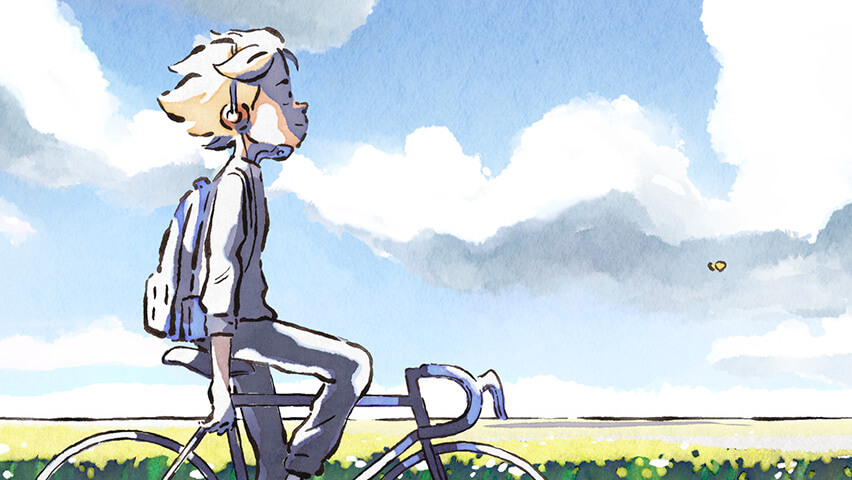
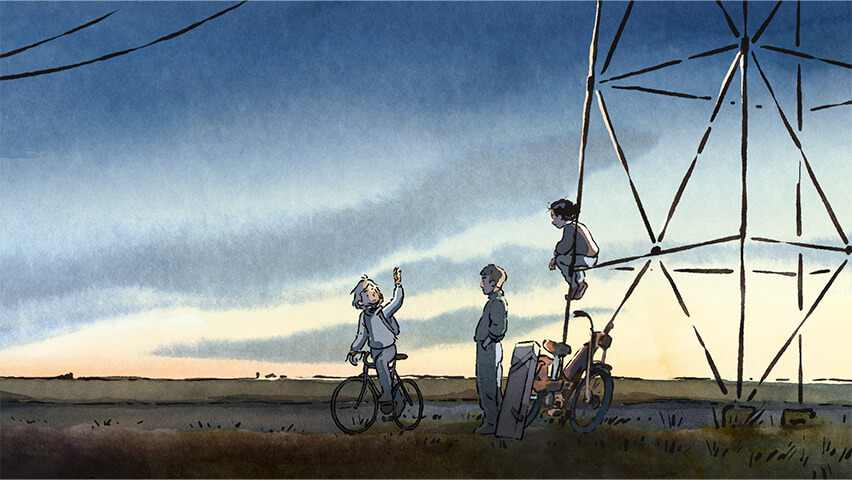
This idea of doing everything right up until the very end also applies to the film’s visuals. For the most part, Iron Boy looks nothing short of astoundingly beautiful. Going back to his 2D roots, Clichy finds a minimalist, inky art style that uses lighting to bring complexity to each shot. Christophe is drawn with barely-connecting outlines that feel like they can barely contain his insides. The characters are wonderfully integrated into their backgrounds, seeming like the wrong movement could see their ink-painted features spill out the sides of their faces. Christophe’s father is drawn with more complete outlines, showing how rigid and established his worldview is in comparison to his son’s.
The backgrounds of Iron Boy are a double edged sword. On one hand, they are wonderful paintings. Each of them would make any living room complete with blue skies and white clouds blending into one another beautifully. Later in the film, there’s a rainstorm, and the variety of background colours are a joy to watch, with the moisture in the air communicated by a still-drying blot of ink or two.
However, the texture and stillness of these backgrounds means that the movie is at a remove from the emotion of the story. In a pivotal scene, Christophe is silently riding his bike, confidently bounding through farmland, having figured something out about himself and about life – a crucial scene in any great coming of age flick. I should have been there with Christophe, feeling the speed of the bike, the wind through his hair, but I wasn’t.
© Sony Pictures Classics
The backgrounds in the film are so textured and abstracted that they remove themselves from reality a step too far. Suddenly the world of Iron Boy doesn’t feel like one where wind blows and wheels bump against rocks on the ground. The film is undeniably beautiful, but it sacrifices a strain of reality to achieve that beauty.
There’s a version of Iron Boy that feels indistinguishable from a memory. It has a nostalgic feel, in its visuals, in its music, in its largely understated dialogue. However, I kept finding myself kicked out of this reverie before I could get too close. I wanted to get cosy in Iron Boy s paintings, I wanted to settle into its grooves, but the film is a tad too clean, prioritising beauty a tad more than realism, and breaks the promise of its progressive attitude towards disability. What could have been a warm hug of a film ends up as a firm pat on the shoulder.
Upcoming UK screenings
- Saturday 7 November 2026, 11:30am: Vue in the Light, Leeds, as part of Leeds International Film Festival. Details and tickets.
- Saturday 14 November 2026, 3:15pm: Cottage Road Cinema, Leeds. An autism-friendly screening as part of Leeds International Film Festival. Details and tickets.
- Thursday 19 November 2026, 12:45pm: Ciné Lumière, London. Also advertised as a school screening. Details and school bookings.
- Saturday 21 November 2026, 2:15pm: Ciné Lumière, London, as part of French Film Festival London. In French with English subtitles. Details and tickets.