

100 Meters | Interview with Kenji Iwaisawa

Back in 2019, Kenji Iwaisawa burst out of the blocks with anime directorial debut On-Gaku: Our Sound. An incredibly funny and raucous movie about a trio of misfit schoolboys who decide to form a band despite their musical ineptitude, Iwaisawa-san’s film is a rousing love letter to finding and pursuing your passion in life that’s augmented by a rich layer of metatextuality: the movie was made on a microbudget of $40,000 — most of which was crowdfunded — over the course of seven long, painstaking years, with the filmmaker himself drawing most of the feature’s 40,000 hand-drawn frames.
Now, Iwaisawa-san is back back back — buoyed by a bigger budget and a bigger animation team (including character designer and chief animation director Keisuke Kojima) — with 100 Meters, an audacious adaptation of Uoto’s eponymous manga.
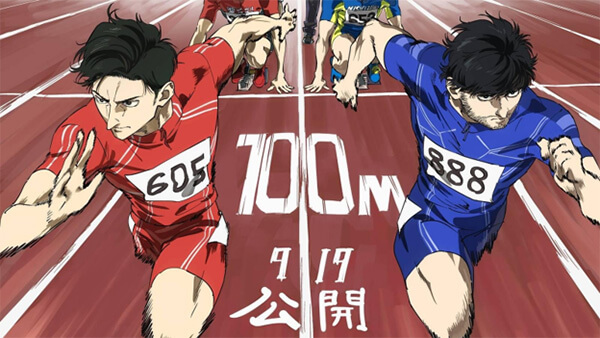
100 Meters’ set-up — two sprinters, natural runner Togashi (Tôri Matsuzaka) and scrappy contender Komiya (Shôta Sometani), meet and train together as schoolboys before becoming racetrack rivals as adults — is pretty standard sports drama material. Iwaisawa-san’s execution of that story however, in his now-signature rotoscope-heavy style, is anything but. Using a striking mix of eye-catching animation techniques that blur the lines between the internal and external battles being fought on-screen, 100 Meters is a kinetic anime that finds Iwaisawa-san pushing the boundaries of the genre and, at its best, the medium itself.
With 100 Meters now available to stream widely on Netflix and having recently had a buzzing, packed-out screening at this year’s Cardiff Animation Festival (in partnership with Kotatsu Japanese Animation Festival), Skwigly headed down to the figurative track to speak with director Kenji Iwaisawa all about making his anime sports movie epic. On your marks… get set… go!
How did you first encounter Uoto’s 100 Meters manga? And what was it about the story that resonated with you enough to want to make a feature from it? I read somewhere that you were into sports yourself when you were younger.
I first read Uoto’s Orb: On the Movements of the Earth, my enjoyment of which naturally piqued my interested in the author. Put simply, a dive into his other works led me to 100 Meters. Regarding why that book especially resonated with me, as far as I’m aware, prior to my movie there had been no Japanese feature-length film, live-action or otherwise, revolving around the 100 metre sprint. So, along with the chance to adapt a work by Uoto, making such a film felt like a worthwhile challenge to me.
And yes, I did play sports when I was younger. I played baseball when I was a student, but our team wasn’t particularly good, so I suppose that experience did not directly influence this film. I will say, however, that the basic experience of having played sports myself means that I find stories about athletes to be relatable. I’ve always enjoyed learning about the lives of professional athletes of all kinds, whether it be through films, non-fiction books, or online articles. I think that this interest has certainly influenced my work on 100 Meters.
Your debut movie, On-Gaku: Our Sound, was a very low budget production that took more than half a decade to make. It is clear watching 100 Meters that you had more money and a greater pool of resources to work with this time around. How did directing On-Gaku: Our Sound, with all of both the financial challenges and creative freedoms of a low-budget production, help prepare you for making 100 Meters?
Yes, On-Gaku: Our Sound was made on an extremely low budget, which was the reason for the seven and half years that it took to complete it. The larger budget available to us for 100 Meters allowed us to complete the animation in just two years, with the help of many highly skilled professionals, although we were still able to incorporate the kind of flexibility associated with independent filmmaking, employing methods that were not bound by established industry rules. In short, our experience making On-Gaku: Our Sound helped us develop a unique approach that did not rely entirely on conventional commercial production practices. A significant number of our team members had little-to-no experience working on commercial animation productions, but despite that lack of experience, they were still an enormous asset to the project.
There was nothing in particular that surprised me when making 100 Meters, but I found that commercial animation production tends to divide responsibilities into very specialised roles, for better or worse, and involves many layers of review and approval. That style of production is not the sort to which I am typically accustomed, so it took a little getting used to.
The way a character moves is such a vital part of animation, and of visual storytelling in any medium. Here, the importance of movement — and what that says about your characters — is even greater. How did you approach crafting the running styles of Togashi and Komiya in this film? And what did you want the way they move to say about who they are as people?
Each character’s running style was based on the running form of a real person, which we then adapted into animation. For the running models, Togashi was given a clean, orthodox form that we considered befitting a standard protagonist, while Komiya’s form was designed to be more distinctive because he is not the type of person who comfortably fits into a conventional mould.
For the everyday scenes, we held auditions for rotoscope actors and selected performers whose image closely matched each character. During the live-action filming sessions, we were able to work together with the actors to develop their characters’ movements, and I think that collaboration is reflected in the final film. Artistic licence was added during the animation stage, but in most cases the animation is based on the live-action performances, adjusted where necessary to make the movement clearer and more effective as animation.
What was your guiding philosophy when it came to executing the race sequences? As a viewer, it feels almost as if you find ways to stretch time itself here, honouring the characters’ struggle both internally and externally in a way I haven’t really seen before. The only comparison I could even begin to think of is perhaps Takeshi Koike’s Redline, which also managed to create a staggering sense of speed while finding space to follow the psychology of its characters.
For the race sequences, I had already decided that the final race would be highly stylised through various animated techniques, so I designed the preceding race scenes with the goal of building up to that climactic race.
One of the defining characteristics of the 100 metre sprint is that the race itself is over in about ten seconds, and I wanted audiences to experience that same sensation of something ending in an instant. At the same time, because the film needed to portray many races, I occasionally stretched the action for entertainment purposes, allowing viewers to spend more time with certain moments and making them more memorable. However, coming up with enough variation between the different race scenes was a real challenge.
Can you tell us a little bit about the challenges of animating that breathtaking long take sequence in the rain? How does a sequence as ambitious as that make it from the storyboard to the screen? And how soon into the process of conceiving 100 Meters did you know this would be a major part of the movie?
The idea for the long-take sequence during the rainy final race came to me before full-scale production on 100 Meters began, when I went to watch an actual track-and-field competition. In that sense, you could almost say that the film 100 Meters began with that long rainy sequence. It was a scene that I considered absolutely essential to realize if I was going to make this film. Because the 100 metre sprint is an event that starts and finishes in the blink of an eye, I felt that a single continuous shot lasting three minutes and forty seconds would have a particularly powerful effect. I believe it allowed us to capture the tension and atmosphere of the moment.
100 Meters (Dir. Kenji Iwaisawa, Image: GKIDS)
This, to me, feels like a love letter to the human spirit. A love letter to the passion that enables us all to pursue what inspires us and achieve our goals. Where did your passion for animation begin? And what gives you the fuel to keep pursuing that passion to this day?
I would like works of art to be present for people in the way you describe, so I would naturally be very happy if this film serves as a source of motivation for those who watch it. My passion may not be for animation itself; rather, the driving force behind my filmmaking is the endless possibilities that it presents.
The Japanese animation industry has a large market, and most productions are created simply to supply that existing demand. As a result, there is relatively little diversity in genres and forms of expression. Rather than creating works aimed at an already established market, I am more interested in developing markets that have not yet been fully established. I believe there is real potential in doing that, and that belief continues to motivate me.
And one final question if I may. Do you have a favourite sports movie? Or a personal sporting hero?
It’s not a film, but I really enjoyed the Netflix drama series Sanctuary, which depicts the world of professional sumo wrestling. I appreciated the fact that the production did not rely on major star actors in its principal cast, which is somewhat unusual in Japan, and instead pursued a convincing sense of realism.
As for a sporting hero, for someone of my generation it would have to be Ichiro Suzuki.* Many athletes who perform at the highest levels of sport seem to possess their own unique philosophies. Reading their interviews and watching documentaries about them sometimes provides inspiration for my own creative work.
100 Meters is available to UK viewers on Netflix
*Ichiro Suzuki is a Japanese player widely considered to be one of the greatest ever. He retired from the game in March 2019 having spent a large part of his career in the MLB in the US, and as of last year is a member of the National Baseball Hall Of Fame.