

LIAF 2025: Life and Works of Emma Calder & Externalizing the Inner

As part of its 22nd edition, the London International Animation Festival screened 77 films out of a submitted 2,400! In this article we’ll offer our small slice of the multitude of screenings and happenings across London.
To begin with, the festival opened its doors at the Barbican with a celebration of the life and works of Emma Calder. Emma was a much-loved figure in the independent animation scene, but she also taught at UCA Farnham and Middlesex University, meeting students who would go on to work collaboratively with her on her films. She passed away in September of last year at age 65 to cancer. However, she was still actively making films up until this time, midway through the production of what was to be her final film, House of Love (2025). The audience had the pleasure of watching the premiere which was completed under Emma’s strict instructions. We caught up with Sofia Negri, who was integral to the team working to bring Emma’s vision to the screen. “We were very grateful when she asked us to continue and finish her film, as well as very sad for her sudden departure. Her daughter Coco was very helpful to assess our decision making and make it aligned with Emma’s approach…, it was lovely to work on House of Love remembering Emma with lots of love and humour, it really helped us to keep us motivated and to convey her energy in the film!”
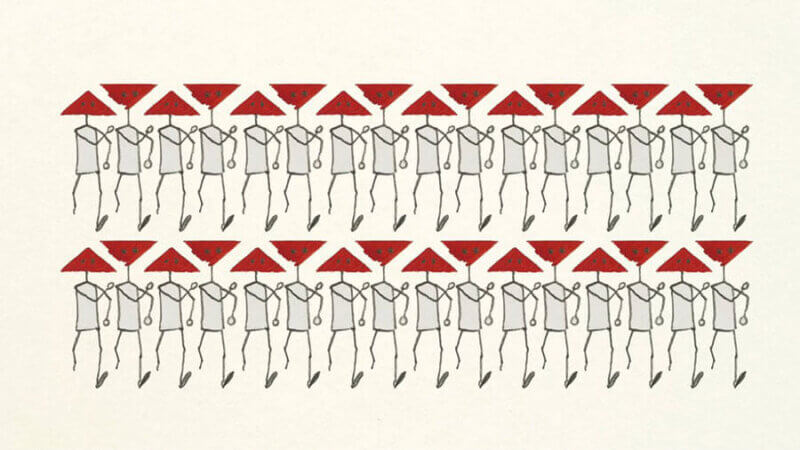
House of Love by Emma Calder
As with any retrospective, it’s so interesting to draw connecting lines whilst witnessing a person’s life’s work. Early films came from Emma’s time at The Royal College of Art. As a Graphic Design student, Emma was experimenting with ways of creating images. An early film, Madame Potato, stole hearts and was to become her graduation film. The titular character was created by potato printing, frame by frame. In a circular fashion, Emma revisited the simplicity of this printing technique with the stenciled figures appearing in House of Love.
Ged Haney, a fellow student and future co-director of Pearly Oyster Productions (established 1984) remarked “She was not the best commercial graphic designer, but it was her wit and depth which struck me” in the panel which followed. In the film, Madame Potato evolves from a soily potato into a potato-print woman, further still, into an overnight sensation as a performer onstage. The question remains: how does one become a refined artiste without forgetting one’s earthy beginnings? Emma was asking herself similar questions as an art student. How do I become successful whilst still remaining true to myself? She sharply defines the way in which Madame Potato is exploited in the public arena, particularly under a lewd male gaze. An early experience of meeting a man with a penis shaped nose in the park sets this tone, yet Madame Potato goes on to have many lovers and male admirers. She is swept up in the dizzying effect of fame, of being observed, but in the end, it becomes too much for her. Escaping a flock of male admirers, MP returns to her birthright. Kneeling down in a muddy allotment, she begins to gorge on starch. This sets off a transformation back into an embryonic state and back into the ground!
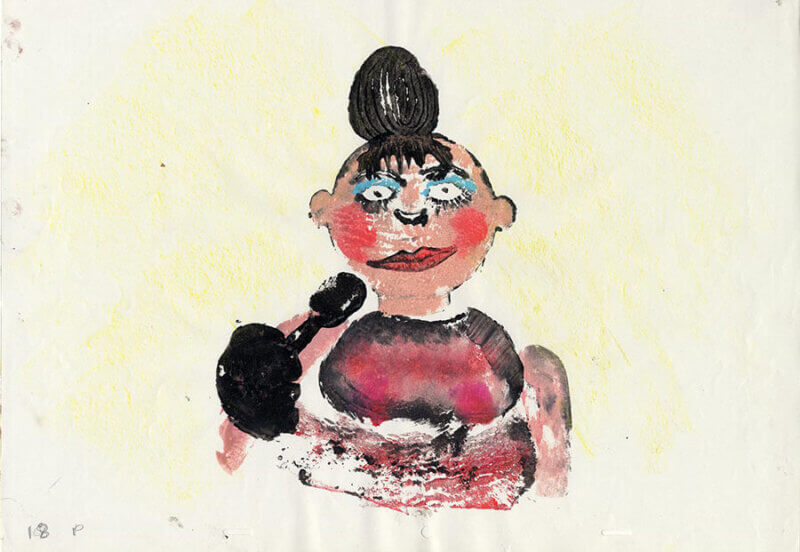
Madame Potato by Emma Calder
Though the film may seem rudimentary with its potato-printing technique, Emma deftly weaves the personal and political. In her MA degree show at RCA she further builds upon MP by creating a life size mechanical Madame Potato which could watch her own film and eat Potato crisps, this later got shown at the TATE. Emma’s vision here is pretty sinister. MP watches her own film whilst simultaneously devouring herself. Was Emma speaking to the feminine experience, or deeper still, her life as a filmmaker? Emma also created a Madame Potato cookbook to draw attention and exemplify her exploitation.
Emma’s penchant for found materials, which later earned her the title ‘Queen of Collage’, contributed to her punky aesthetic and rejection of anything slick or commercial. These values appeared to transfer to her character also. In the discussion that followed, Ged Haney, Fiona Woodcock, Jonathan Hodsgon, her husband Julian Cripps and daughter Coco gathered to share anecdotes about Emma. Jonathan dwelled on her having a certain aura about her during their time at RCA. She had incredible confidence and she was great at getting people to work with her. Ged recounted an episode of her stopping traffic on the streets of London. It was then that Julian brought to attention her persistent political stance, how she lobbied in parliament for animation in 2002 in the hope that it would gain credibility as an independent art form. The effects weren’t immediate but come 2019, the BFI created its high-end short film fund which enabled Emma to make her film, Beware of Trains (2022).
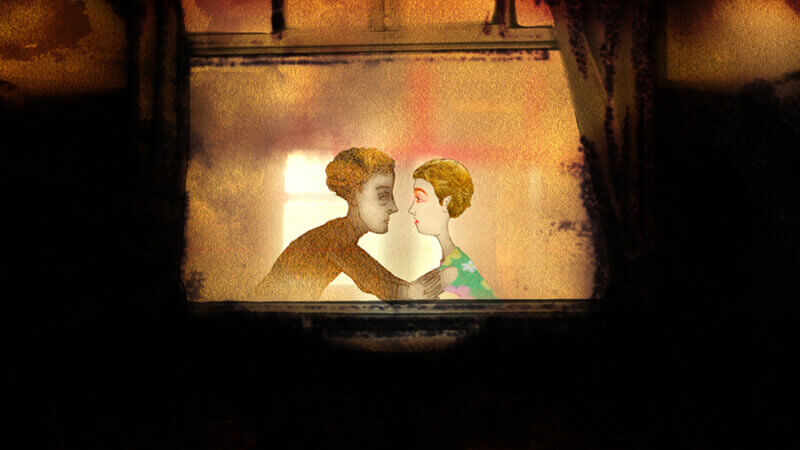
Beware of Trains by Emma Calder
The idea for Beware of Trains originated from a dream Emma had over 20 years before its completion. She wrote a stream-of-conscious story triggered by this nightmare. The film revolves around a psychotherapy session where a woman sits and ruminates: “I had a dream I had murdered someone, and I couldn’t get it out of my head”.
Between train compartments, stations and hospitals, Emma’s character navigates a world, made liquid by the unconsciousness. She draws endlessly on a disturbed experience with a stranger in a train carriage in which he touches her arm and draws her toward him. The psychosexual potential in this meeting is made terrifying explicit in a final scene between the woman and a dead train driver, with whom she has sex with. The train thrusts through a dizzying landscape. It’s going to crash. It might be her fault. The woman in the film knows she needs help, she is a seeing a therapist, yet at the same time she seems magnetized by her own demise, she is close to a nervous breakdown.
Emma’s film touches on the nature of the unconscious, it’s capacity to contain a simultaneous yes and a no, an instinct to be transformative and perverse. The obsessive way in which Emma zeros in on her dream, her persistence to see it to the screen, is perhaps the very weft she weaved with in order to make this film, cementing its compulsive and striking tone. Beware of Trains is arguably Emma’s masterpiece. Watching it alongside her other films certainly gives the impression that this was the film she had been training to make all her life, transmitting to the viewer like a great flood of pent-up content.
Little fragments of Beware of Trains appear in her other works. The pattern of the woman’s dress appears in episodes of Random Person, a quickfire web series she used to experiment with new ideas. This is probably something to do with it being 24 years in the making. Emma had reimagined Beware of Trains a number of times before she had the opportunity to make it. The money did eventually come however, a week before Covid lockdown. This brought the film home in unexpected ways. Pretty soon her partner and children began to work collaboratively on the film.
Julian Cripps, with his background in architectural design, mentions that they had kept their work separate up until this point. But it seemed natural to join in with background design and to make an automated track so they could animate Emma’s old toy train. The collaged face of her main character was made up of photographs of her family, her eyes and also her son’s Olivers, the lips were Cocos. Oliver also contributed a trumpet solo into the composition which was led by John Webb. In a sense, Emma’s personal life was intimately collaged throughout the film, resulting in something quite visceral. Sofia reminisces about Emma, ‘She was so hard working and disciplined but in a very spontaneous way, like a second nature. She lived by and through her art, which was always around her in her studio and at home.’
Niko Radas, another filmmaker at LIAF this year, brings lived experience closer to the heart of his process with his film Psychonauts (2025). This film was exceptional in its origins. Nikos worked full time at at the University Psychiatric Hospital Vrapče in Zagreb for 20 years, before the therapeutic workshops he ran eventually evolved into an animated short film.
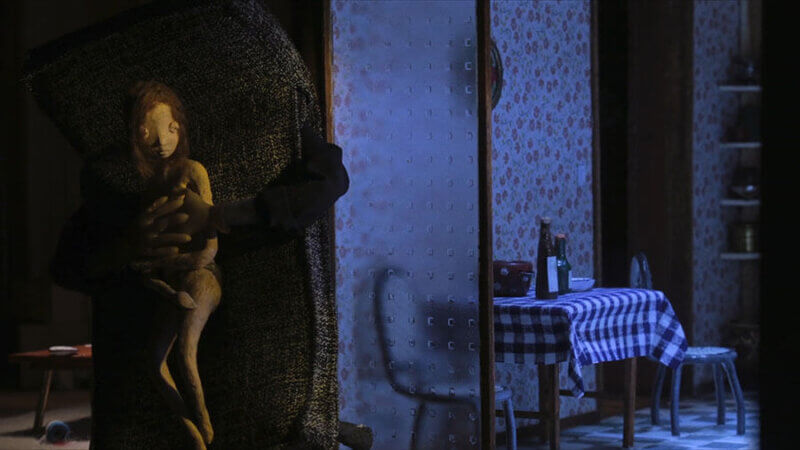
Psychonautsby Niko Radas
71 in-patients of the secure forensic ward collaborated on props, sets and stop motion animation. What resulted was an idiosyncratic sojourn into their experiences. The setting, Pharmolopolis: A wooden-slat city which appears to turn drug boxes into dwellings, each building displaying text of an imaginary medicine such as Dizzytex, Saliva Pharma and Serotonix. The camera never stops moving in Psychonauts. As we glide through the synthesized city and explore its totality, we are introduced to a host of characters or, as the synopsis reads, ‘mental disorders,’ which ‘take on anthropomorphic forms and find new refuges’. A man with a overlarge head, burgeoning inside a lift as he attempts to leave his apartment, another enters a trance-like state and begins to levitate in space, a woman tries to leave her bed but finds she is inextricably attached to it. As she tries to move around the room, it holds itself tightly to her like an overbearing lover.
These scenes are set to a bizarre musical score of autotuned lyrics, which somewhat make the film. Voices from the patients themselves recount in sing-song the instructions on drug packet leaflets: ‘Side effects may include…’, ‘If you miss a dose, do not double dose’. These clinical instructions are reinterpreted into a surreal soundscape, a precise harmony for the disharmony of their experience. In interviews with Niko Radas, the director illuminates his reasons for creating a film which primarily serves the therapeutic purpose. Engaging in the creative process is a way for patients to relate to their illnesses through an alternate lens. Niko worked with his patients consent at every step, offering a sense of ownership to their work.
Niko’s film pushes boundaries because it pulls into question what filmmaking actually is and who it is for. He even mentions that Psychonauts is not the first film made in collaboration with his patients. The other films served their therapeutic purpose, but they did not go as far as to submit them to festivals. Does this make them any less of a film? If we think back to the image of Madame Potato eating crisps, it is art feeding upon itself, or, more accurately, the artist sustaining themselves with the art. Both Emma Calder and Niko Radas are adept as filmmakers in their propensity to transcend an initial purpose to filmmaking. Their films are outward looking; they externalize the innermost of human experiences. Mental health and mental illness enter the realm of the transpersonal as they are related to us through animated film.
Elsewhere at LIAF, the Playing with Emotions shorts selection dealt with the core of individual experience. The films which were the most successful were those which achieved these transpersonal aims. Take the Stone of Destiny (2025) for example, directed by Julie Černá. An anthropomorphized stone takes us on another musical journey situated in a much more upbeat universe this time. Černá’s animation has a dreamy aesthetic, between sandy beaches and houses filled with plants. The Stone of Destiny goes about their daily activities accompanied by cutesy yet rather impenetrable lyrics ‘‘I read the expressions of my surroundings with deep understanding”.
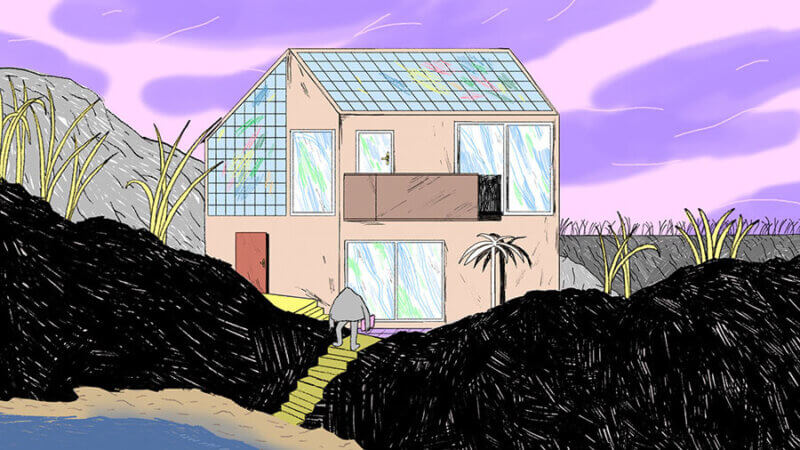
Stone of Destiny by Julie Černá
These activities include peaceful acts of watering plants in an apparently unoccupied villa by the sea. It is unclear whether they live here or are more so an entity just passing through. Soon, an unnamed dark figure joins them in the villa. A demon, who is actually quite caring and puts chocolates under their pillow. But then there is the nemesis of the Stone of Destiny! Every so often a horse with a flailing mane appears and is a point of anxiety for the Stone. This causes them to eventually leave the villa, singing ‘It’s too crowded for me here’ despite an appearance of space and luxury.
The scenario in The Stone of Destiny is strange, somewhat whimsical, but could it point to a more universal experience? The happy-sad tone of the lyrics attempts to characterize a complex set of emotions revolving around arriving and departing, a desire to escape hidden inside every new experience or scenario. This existential Stone is driven by a desire for freedom, but they first must understand what it is they are escaping from.