

Duck and Frog | Q&A with creator/director Sam Shaw

Skwigly and Bristol Animation Meetup (BAM) continue our series of articles dedicated to the Bristol animation scene. Having been among the first round of selected projects to move forward as part of the UK animation initiative BBC Ignite, Duck and Frog (50 x 7’) marks the first series to make it to broadcast, having debuted on BBC iPlayer last Friday and airing on CBBC from today.
Produced at Bristol’s Sun & Moon Studios, the series is created by local animator Sam Shaw, whose prior work spans illustration, shorts, music videos alongside key roles on Chicken Run: Dawn of the Nugget, Maddie + Triggs, Kit & Pup, Hammer and Bolter and Doctor Who: The Macra Terror. The world of Duck and Frog sees its titular duo engaged in a series of slapstick misadventures in the modern British world, often oriented around Duck (voiced by Humza Arshad)’s attempts to keep employment being scuppered by Frog (Kevin Eldon)’s interference.
Skwigly touched base with Sam to learn about the characters’ origins, the Ignite development process and the team that brought the concept to life.
It would be great to chat a little bit about the work that you’ve been up to over the years. Were you always from Bristol, or did you get called here?
I definitely got called here. I’m originally from around Cambridge way but, like everyone who’s a fan of animation, you end up trying to get into Bristol as fast as possible, because of Wallace and Gromit and everything like that. But throughout the whole area, especially when I was first looking around, I saw so many little independent studios making amazing things. So in 2011 I smuggled my way into UWE in Bristol, graduated in 2014 and, thanks to a very nice studio called Sun & Moon, I have been employed as an animator, a storyboarder, a designer, a director – anything I’m allowed to do! I’ve got to work on some amazing projects, most recently Maddie and Triggs, which just dropped, which is a beautiful CBeebies/RTE show about a comedy duo of really heartwarming characters. I’ve also been able to animation direct for Chicken Run 2, for the 2D segments, which was incredible, really good fun. I even got a bit of a bucket list job when I worked on the recreations of some old Doctor Who episodes with my favorite doctor, Patrick Troughton.
So the Ignite scheme kind of marks the turning point into creating and directing your own show. How did you kind of get wind of it initially?
It rippled through the animation industry in a crazy, crazy way, just word of mouth, everyone was talking about this initiative and how open it was. I think Sun & Moon did a few, but the one that got through was Duck and Frog, my own idea. I’d just thought to myself, If I don’t try and put them out there and see if it floats, I’ll regret it forever, so I took a chance. I’ve been drawing them for goodness knows how long, since before uni, so it was a matter of seeing if anyone else liked them and, if not, I’ll just keep drawing and animating them in my spare time. But yeah, luckily it all kind of worked out in a pretty amazing way.
So it existed before Ignite, did you have to tailor it at all to meet any brief specifications?
It wasn’t necessarily to meet brief specifications. They existed for a very long time, just as a comedy duo in my third year short film, and then just like GIFs and short films going forward. So it was just about refining what was there and collaborating with the BBC to develop their character dynamic. Originally, Duck was very much the straight man and the boring one and Frog was the anarchic, chaotic ball of energy that would keep the momentum of the show going. The BBC really wanted to make sure that Duck was funny in his own way as well, so we really fine-tuned his character to give him neuroses and innocence and naivety, as funny as Frog’s boundless energy and light narcissism. So yeah, it was more about just whittling down what we could, making sure that dynamic could work in a really good way, and making sure that the format of the show had longevity. Because originally, the idea was that Duck would get a job every single episode, and Frog would just infiltrate it and sneak his way in. But they came up with a really good idea of making them flatmates as well, so Duck is being hassled both at work and at home. It created a lot more scope and ways we could fun with these characters and have them interact with each other, which is the main core and the unique selling point of the show, I think.
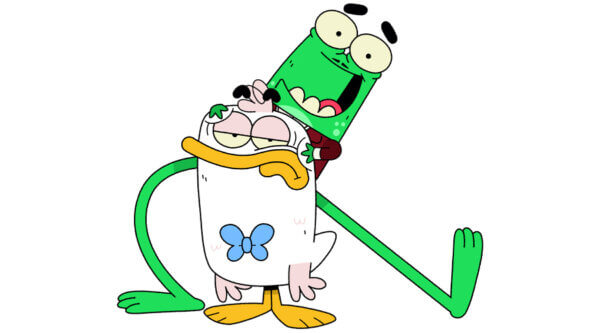
Duck & Frog (BBC)
Ducks have popped up in a few other things of yours, as I recall. Do they have a particular quality that draws you to them?
Yeah, I think ducks are just really good people. I was brought up in a little council house, but my mum used to rescue any poultry she could find that just needed a home. So a lot of my upbringing was just raising ducks in my room; the first animation I ever did was done with a duckling asleep on my shoulder. But that aside, I’m a massive cartoon nerd, so the best cartoon animal is always a duck – Duckula, Daffy, Donald – I’ve always gravitated towards those characters. So yeah, the second it came for me to make a character that I wanted to draw for like, 15 years, I knew it had to be a duck.
When you’re developing a show like this, that needs to be sort of targeted toward a specific viewership, do you find yourself watching shows for that age range a bit more, to get a sense of the lay of the land?
That’s a really good question. As a cartoon nerd, I’m watching them anyway and trying to pick up on visual language and pacing, especially from the more fast-paced ones. Spongebob, Teen Titans Go! and Danger Mouse are really good and kinetic and punchy, and keep attention. They’ve definitely been an influence in how I’ve directed this. The age range is somethingwe’re super conscious of, and the BBC have been fantastic with either “No, there’s no way that’s getting through” or “Yeah, we can try and make that work, because that’s really funny”. So they’ve been really up for pushing the comedy a bit further than I even expected, which has been absolutely lovely.
I saw that (veteran BBC Commissioning Editor) Jo Allen was involved. Was that her area?
Yeah. she’s got a great sense of humour, she was really pushing for some jokes, it was lovely. I thought that so many of the initial ideas in the scripts would just be met with “No, can’t do that”, “That doesn’t make sense”, “A kid might not get that one”, but they’ve been so open to the collaboration of it, within the BBC guidelines.
Can you break down the phases of development the show went through once it was selected for Ignite?
There were a lot of stages. The process changed a little bit as it was going along, and there were a few stages where they were refining pitches and selecting some for the next round and the next round. I think that happened three times before it was commissioned, or greenlit, and that’s when the real work has to happen, where you’re going to places like Cartoon Forum and pitching for collaboration and distribution and funding and stuff like that. So even when Ignite’s happened and it’s been selected, there are still hoops to jump through. But the BBC was super supportive throughout and it never felt too daunting or stressful.
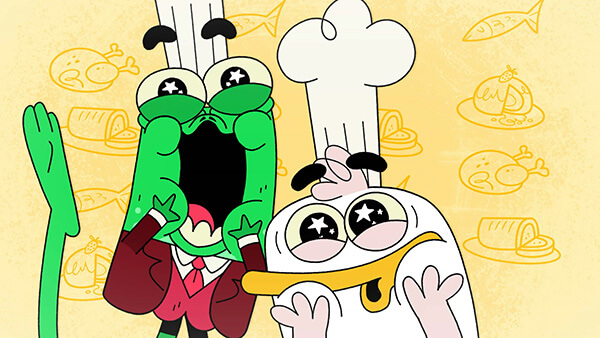
Duck & Frog (BBC)
I was also interested in the casting process for a show that doesn’t have dialogue.
Frog is played by Kevin Eldon, who has been amazing with the amount of prep he’s done for every episode. He comes into the recording booth and he’s practiced and rehearsed the character, he’s really invested in it. That was so lovely, to have something that’s just been sitting in your head for donkey’s years be better because of someone else’s input. And the same goes for Humza (Arshad), who plays Duck; the second we heard him, we were like “This is the perfect Duck”. They’ve both been incredible. I thought it would be a lot harder to get people who are willing to just make the right noises. But both of them were instantly just bulldozing their way through the scripts and making the characters completely their own.
As it’s very slapstick comedy-oriented, are they working to a script or do they have visuals to work off of?
We record during the animatic phase, so we’ve got a locked animatic and they’ll run through the scenes a few times. As that’s going on, we then build a library of their sounds and stuff. So we have all of the “Hmm”s and “Aah”s and stuff we need, so they can focus on the really silly, bespoke stuff we want. Like, we’ve got Frog scatting in an episode, and it sounds incredible.
And I’ve seen on the screeners that I’ve watched, you’re credited as the director -is that the case with every episode?
I direct 49 out of the 50, with one episode directed by my Assistant Director, Erinn Lucas.
Had you done much directing before?
A little bit, never anything this big. I mentioned that I got to be the 2D Animation Director on Chicken Run 2, I also did a little bit on Maddie and Triggs as well in an interim period. A lot of client work, a lot of agency work, but nothing quite at this scope. It’s lovely that the BBC took a bit of a chance on that.
I’d imagine, when they’re characters that you go back with a long way, there’s sort of a personal connection where you want to have that aspect of control – but at the same time, you’re kind of giving up some elements, handing it over to other animators, other departments. Was that a tricky part of it?
I thought it would be harder than it was. Luckily, we employed really, really talented people, so that was great. I’m especially keen on design, and very picky about it, so I thought I would be all over that like a hawk, but we’ve got some amazing artists who have drawn it better than I ever could (annoyingly)! So that’s really helped. I was over storyboards quite a lot, and I’ve storyboarded quite a few episodes myself, but again, that team has just knocked it out of the park. The funniest episode isn’t boarded by me, and it’s so much funnier. The choices that have been made are so much better than the ones I naturally would have, and that’s how this show has gotten so good, by adding on to what was originally there.
The credit list has a lot of names I’m very happy to see grouped together. Did you have any say in assembling that team?
A little bit, especially when it came to picking the directors, and then I would basically delegate. The people who were running the departments know them better than I could, so I didn’t want to step on any toes, and I wanted them to be able to make it their own, as well.
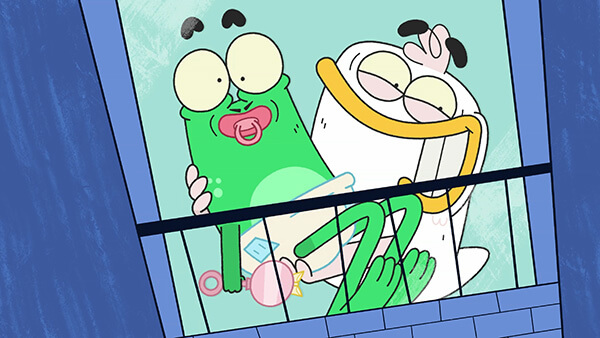
Duck & Frog (BBC)
For the stories themselves, are you coming up with the initial concepts and having them fleshed out, or is the writing team pitching ideas to you?
Writers pitched ideas. I had a few that I wanted to do, that I gave as a springboard. But everyone came in with, I think, two or three ideas to the writers’ rooms, and then me, Sun & Moon and our amazing Head Writer Alex Collier would all talk in a massive Zoom meeting for half a day, just going through those ideas, developing them there and then, and selecting the ones we thought were good. We had Jo Allen in the room for a load of those as well, who was also chiming in with some really, really good ideas. Then we would take those ideas and have a little discussion internally, and select the ones to go ahead with and develop with some notes, and then have a few rounds of feedback with me and the BBC, and then they’re done!
Well, I’m looking forward to seeing more episodes, now that you’ve birthed it into the world – are things calming down for you a bit, or are you jumping onto something else?
We still have 25 episodes in the oven that need to get done pretty soon! So, yeah, if anything, now’s the busiest part. This interview’s been the most relaxing thing I’ve done all day!
Duck and Frog is available to watch on CBBC and iPlayer. You can follow Sam Shaw on Instagram, BlueSky and his website.
For more on the work of Sun & Moon Studios visit sunandmoonstudios.co.uk
Bristol Animation Meetup is an initiative of Skwigly Online Animation Magazine, Rumpus Animation and Sun & Moon Studios. For updates follow us on Instagram.