

The Day The Earth Blew Up: A Looney Tunes Movie – Interview with Director Peter Browngardt

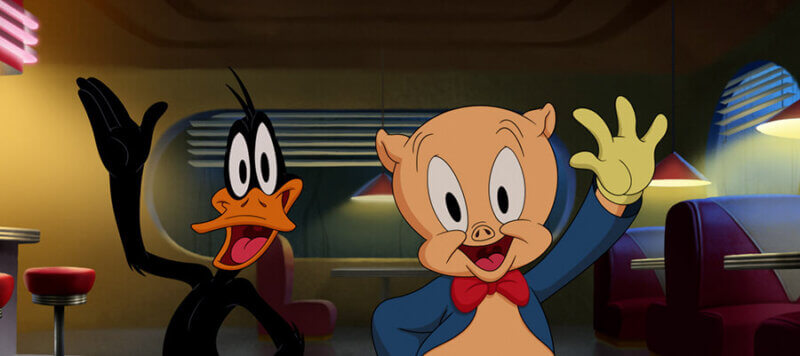
From 2020 to 2024, Peter Browngardt led a team of talented animators in crafting fresh hijinks for the Looney Tunes crew in the form of Warner Bros Animation’s Looney Tunes Shorts. But that’s not all, folks! Following a long distribution journey, the first-ever feature-length Looney Tunes outing, The Day The Earth Blew Up, crashlands in UK cinemas this month. A raucously entertaining sci-fi B-movie adventure starring perennial favourites Porky Pig and Daffy Duck, the film sees an alien invasion encroach on earth with the aid of some particularly unusual chewing gum. Browngardt’s film is quirky and offbeat, but it’s far from an acquired taste – it has the soul of classic Looney Tunes at its core, and plentiful fresh ideas built around it.
Ahead of the UK release, we sat down with Browngardt, who directed, co-wrote and executive-produced the film, to talk about Looney Tunes past and present, and the many considerations that went into such an epic animated undertaking.
What first sparked the idea of spinning the Looney Tunes cartoons into a fully-fledged feature film?
Peter Browngardt: I was doing a series of shorts for Warner Brothers Animation called Looney Tunes Cartoons. One of the executives on the project asked if I had any ideas for a movie. I thought [Looney Tunes] worked so well in shorter form that I couldn’t figure it out in my head right away. But I went away and I started thinking about it.
I tried to think of comparables out there in the world — iconic comedic characters that started in shorts and then went into films. One that really stood out to me was Abbott and Costello. They were short subjects, live-action of course, and comedic. And they were an iconic duo. I focused in on Porky and Daffy, because they’re a duo that play off each other so well as far as yin and yang personalities. And then I thought of Abbott and Costello Meet Frankenstein, and [arrived at the idea of] putting it in a genre [mode]. There’s that saying that you should come up with ideas that can do a lot of work for you, that immediately create a lot of storytelling scenarios or conflicts. What if it’s Porky and Daffy in a sci-fi B movie?
That genre has always appealed to me. Tim Burton was a huge influence on me as a young adult. Pee Wee’s Big Adventure kind of set me on this path in a weird way – Roger Rabbit too. Everything I come up with is kind of weird. Gary Larson’s Far Side. Mad Magazine. Put those four things in a blender and you’ve got the sensibility that formed me as an artist in a lot of ways.
I went back to those films and created a mock poster of what the movie could be. I pitched it to the room. I said: what if Porky and Daffy are in a sci-fi B-movie, sort of like an Ed Wood movie? They have to save the world, they’re our unlikely heroes. They put us in development. Then I started work with my team of writers, and my team of storyboard artists that are also writers, and we went down that road.
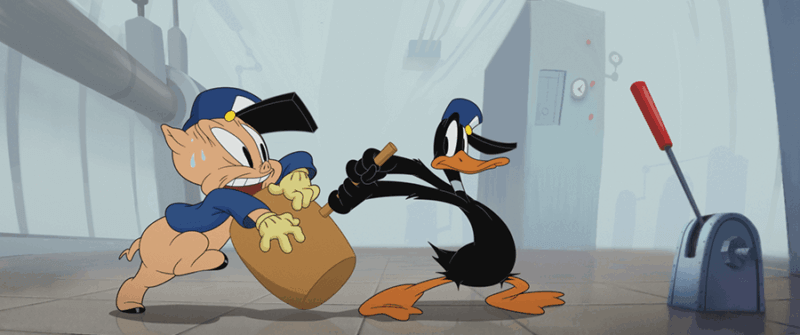
You mentioned that Looney Tunes has a clear, defined tempo in short form. Was there concern that you couldn’t sustain that in feature form?
Absolutely. I never told a story this large before in film or television. The longest thing I’d ever done was like 20 minutes. So I really did our homework and watched a lot of films. I’m a cinephlle, so I took that very seriously. This is an amazing opportunity, obviously – how do we figure this out? Most people on the production had never worked on features before either, even my story team. So it was figuring it out, doing a lot of homework and studying it and going: how do we make the first original Looney Tunes movie? I mean, there’ve been compilation films in the past, and of course, there’s Space Jam. But those were hybrids.
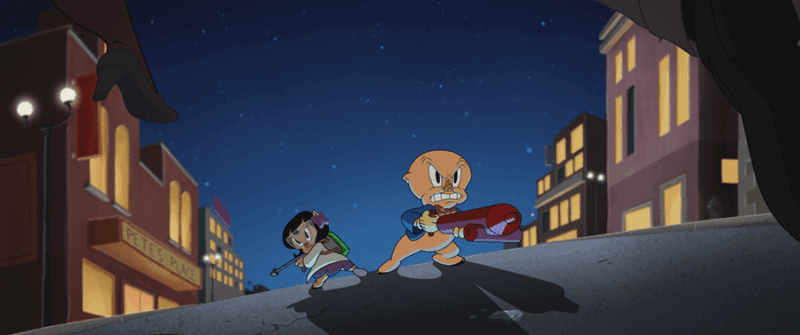
The big thing was creating an emotional thread in there that an audience can hook into. I felt confident we could hang for thirty minutes and not have them walk out of the theatre, but to retain them for ninety minutes? You have to have more than funny gags and drawings. You have to have something with a little more resonance to it. So it was finding that emotional strength, the core in their relationship – and then putting Petunia Pig in there to throw that off and also add to that and help them evolve as characters was really important.
We made the movie three or four times in animatic form before we landed on what made it to the screen. In relative terms, most features probably remake fifteen to twenty times. But we didn’t have that luxury, we didn’t have the time or budget to do that. We just had to bring our A Game as much as we could. And we had support from Warner Brothers Animation as far as letting us do our thing and feeling confident that we had good instincts with what we were doing.
Tell me about the aesthetic approach. You’ve worked from Bob Clampett’s classic designs as foundation and created a pleasingly readable style – with bold outlines that make it clear to see what characters are, where they are, what they’re doing. Is that an aesthetic chosen out of attractiveness, or is it more the kind of ease of animation that that gives you?
Definitely not easy – totally attractive. Doing a 2D feature and trying to get the quality up to theatrical standards is very challenging nowadays. There’s definitely people out there that can do it, but being able to assemble that team and [coordinate] availabilities and training people up… Looney Tunes’ style of animation is very different from the Disney feature approach to animation. The Looney Tunes directors and animators of the golden era were kind of the class clowns, the pranksters – Disney were like the A students in class, to make a comparison. And I feel like you have to have that sort of punk rock or anti-authoritary or even sort of sadness. It’s just being a real satirist – how do we take the piss and vinegar out of shit and make it funny as hell?
So that was the approach. And I think Bob Clampett was the most progressive director of that time, in that he grew the fastest. He was an artistic prodigy and rose through the ranks very quickly in that studio. The other comparable would be Tex Avery. The whole sensibility is text, and I’m a huge fan of that. But yeah, mid-’40s Clampett was the aesthetic. We thought it looked like cartoon candy. The volumetric designs; the pushed animation; how caricatured everything is – it’s not easy. Most people think of the Chuck Jones style of Looney Tunes, which is incredible in its own right, but we wanted to take a Clampett wacky sort of irreverent approach to make the movie the best we could.
How receptive do you feel modern audiences are to Looney Tunes? Have mass audiences maybe forgotten its charms?
I’ve been in situations where young kids don’t know who the Looney Tunes are. I think the awareness is maybe down. Of course, animation fans know what the Looney Tunes are, and know how important they are.
I discovered Tubi over this past summer with my family – I love Tubi. They licensed the classic Looney Tunes to Tubi, and they’re doing exceptionally well – they’re evergreen. I mean, the classic Looney Tunes transcend time. They’re perfect mirrors of our world and our culture, and what we are as people. They’re universal truths, right? Everybody feels shame. Everybody feels anger. Everybody feels guilt. They are beautiful, heightened representations of those aspects of human beings, and that’s why people relate to them. I know a guy like that. I want to be like that. Those type of feelings. And it’s so hard to achieve, but they had four decades of achieving it. They created these lasting masterpieces of cinema that I think everyone needs to watch. They speak to every culture on Earth.
Everyone can watch a Looney Tune and enjoy it. I’m sure some people don’t like it, but I’m very sceptical of those people.
Watching this film, I found myself most of all reminded not only of classic Looney Tunes, but of post-Disney Renaissance films, mid-noughties features – The Iron Giant came to mind as well. Was this project a conscious throwback to that era of feature animation?
Definitely. I mean, we had people that worked on those films involved in the project. We had some ex-Disney feature animators that worked on Lion King and some Bluth guys.
It’s becoming a lost art form in a way, to really know that skill set to make that traditional 2D animation. There’s a younger generation that loves it, but like those guys were trained in such a different process. I was at Cal Arts when The Iron Giant came out and some fellow students actually worked on The Iron Giant while they were at school. So I got to see rough cuts of The Iron Giant before it came out. We all knew how incredible that film was and we wanted it to be humongous. And of course, it didn’t perform as well, but it’s become sort of an iconic masterpiece of the modern era, one that everybody goes back to and doesn’t get old. It’s such an excellent film.
As for genre films and sci-fi, Invasion of the Body Snatchers was a big film for us, both the original and the 70s version. John Carpenter’s The Thing. Sam Raimi films. Ridley Scott’s Alien is a huge film in my life. And we really wanted our film to have its own look. Those films all have a very distinct art direction, style and feel.
We put together an amazing team of artists. I mean, when you say you’re making a Looney Tunes movie, it’s a great call. We were able to train people up and get them ready to help try to tackle something [feature-length] of the calibre of the shorts that we did prior.
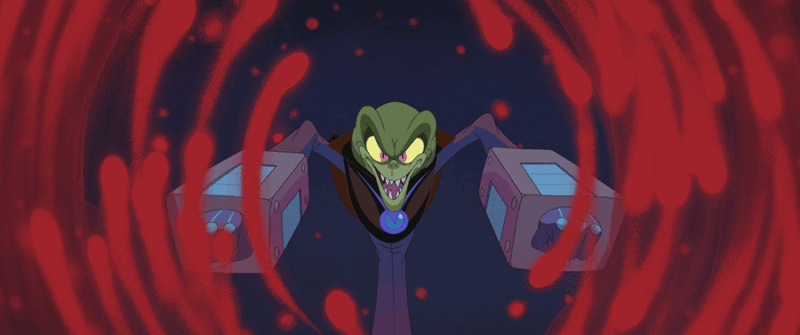
Tell me about the sight gags in this film. It’s so incredibly comedically and visually dense. You’ve got alien goo capabilities that you demonstrate in one shot and never show again. You’ve got factory sequences that feel like they’re out of Charlie Chaplin’s Modern Times. You’ve got a shot of Daffy Duck slamming his head in a car door that appears to be a nod to a particular Internet meme. You throw all these things together – how do you make this symphony coherent?
We targeted certain ideas for set pieces early on, like that Busby Berkeley kind of Art Deco styling. One of the producers on the show, Alex, threw that into the pot. I knew I wanted to open with a short, and then sort of break out of that. That was really fun to figure out. The gum monster and that whole laboratory sequence was an Evil Dead nod. Animation is not for kids, it’s for everybody, but I think having fear and scares in children’s storytelling is important. I don’t mean to do it in a malicious fashion, but in a creative fashion, because I feel like it captivates children’s imaginations. I’m a huge Roald Dahl fan.
With the gag stuff, I didn’t care if it was a modern joke or a retro joke. When you make an animation, you watch it a lot. You’re watching it from script to thumbnail storyboards, to multiple animatics, to rough animation, to final animation. Every single shot you’re watching 50 to 100 times, maybe more through the production – so the joke has got to be something that lasts. I remember hearing that when they do table reads on The Simpsons, if a joke fails, if it doesn’t continue to get a laugh or chuckle or smiles when they read it multiple times, you’ve got to throw it out. So that was the rule. Nothing else was hard set as long as it made us laugh and felt on brand as of Looney Tunes.
This project had quite a tumultuous distribution, and it arrives in the UK with quite a different surrounding state of play to its US release last year.
Every film is a journey, and everything in this business is a process. Sometimes the stars have to align for things to get made or greenlit – no one’s got a free pass. I’m very grateful not only to Warner Brothers Animation for keeping faith in us and believing in this project, but also Ketchup Entertainment. I’m really proud to be the first of the new Looney Tunes movies that Ketchup’s distributing. I’m very happy that they are holding the torchbearers of these amazing characters and franchise. I actually got to know the director of Coyote Vs. Acme a little bit.
It’s a special thing, animation. When you create something in animation, it has a very long shelf life, which is nice. Who knows what the future holds, but there was a really special moment in time that we got to come together and make this film. I’m excited for everybody to go see it and check it out.
Would you make another Looney Tunes feature of this scale?
Oh, just waiting for the phone call. I absolutely would love to. I think there’s many more stories to be told with these characters – many types of stories.
The Day The Earth Blew Up: A Looney Tunes Movie releases in UK cinemas on 13th February 2026.