

The Girl Who Cried Pearls | Interview with Oscar-winning directors Chris Lavis and Maciek Szczerbowski

UPDATE 15/03/2026 – The Girl Who Cried Pearls has won the Oscar for Best Animated Short Film at the 98th Academy Awards.
Known for such masterworks as the Genie Award-winning, Oscar-nominated Madame Tutli-Putli, the Maurice Sendak adaptation Higglety Pigglety Pop! or There Must Be More to Life and the stop-mo VR experience Gymnasia, Clyde Henry Productions have consistently pushed the envelope in the world puppet storytelling, both animated and live-action (and sometimes both). Their latest collaboration with the National Film Board of Canada (NFB) is The Girl Who Cried Pearls, a stunning original fable initally inspired by a mishap during production of Madame Tutli-Putli (in which the titular puppet’s pearl necklace came undone and scattered across the set), growing over time to become an elaborate tale of a young boy’s love toward his unknowing, abused neighbour, who every night cries tears that impossibly crystalise into pearls. Set against a meticulously-crafted backdrop of Montreal in the early 20th century, The Girl Who Cried Pearls is a captivating exploration of yearning, greed and manipulation. With the film currently screening at Manchester Animation Festival as part of their in-person and online Animation Mixtape programme, Skwigly were delighted to catch up with directors Chris Lavis and Maciek Szczerbowski on their latest stunner.
When last we spoke, Clyde Henry had recently completed Cochemare. Having followed the work of the studio since Madame Tutli-Putli, it’s been fascinating to see the different directions you have gone with your work over the years, and the different approaches taken with mixed-media. Can you talk a bit about how the studio has grown in the past decade up to The Girl Who Cried Pearls?
Following Cochemare, which was an experimental stereoscopic film, we spent the best part of the next decade exploring virtual reality. The film, or experience, that came out of that process was Gymnasia which taught us a great deal about the power of puppets to elicit a strong emotional response, no matter the medium. And it became clear that the rest of our career would probably be defined by exploring the limits of puppets on screen.
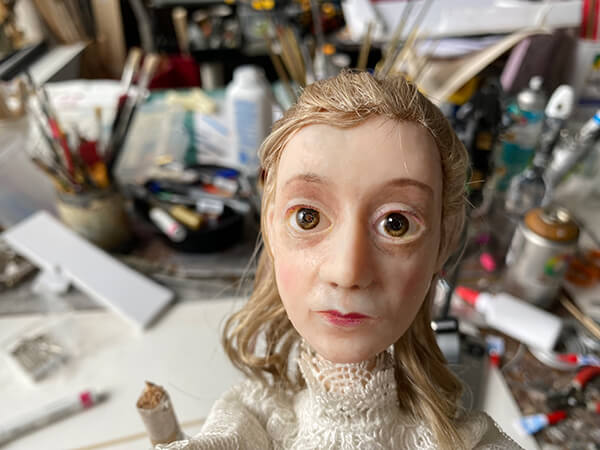
Handmade puppet for The Girl Who Cried Pearls (Credit: Clyde Henry Productions)
The film has all the hallmarks of being adapted from an existing fable, but I gather it is an original story; what brought the idea about initially, did it stem from anywhere in particular?
The goal was a story that felt like it had existed for millennia. In truth, it only goes back as far as the making of Madame Tutli-Putli, where one night we came up with this idea of a poor girl crying pearls, and a poor boy who is torn between his desire for her and his desire to get rich. But we put it aside because we couldn’t solve the ending. That’s not unusual for us, we have dozens of half-baked ideas that never come out of the oven, for one reason or another.
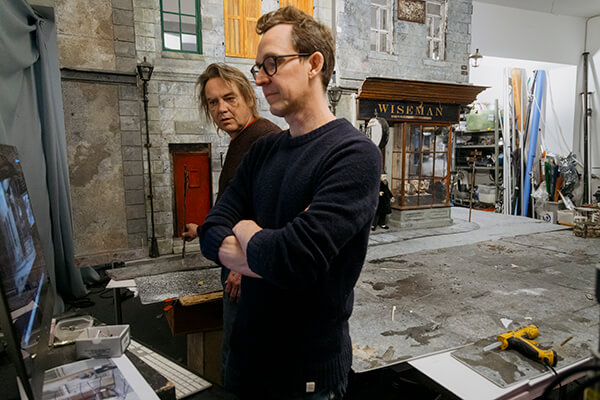
Chris Lavis & Maciek Szczerbowski (Credit: Martin Gros)
I believe that production on the film went back to 2020 – did the pandemic throw things into disarray at all, or compel you to steer your approach in a way you might not have done otherwise?
The film’s production was defined by the pandemic. It affected every aspect, but it wasn’t all negative. The first few months of isolation allowed us to fully concentrate on the sculpting and building of the puppets instead of our original plan, which was to multi-task and work on the animatic, schedule, and editing all at once. The puppets definitely benefited from that singular focus.
The presentation of Montreal in the early 20th century is very nicely done. Was there much by way of research into how the city and architecture looked at that time to keep its representation authentic?
We love the research phase of any project, and we spent months gathering material on the neighborhoods, architecture, clothing and streetcars of the era. But the ultimate decisions were artistic ones, and we were happy to throw accuracy to the wind if it made for a better story.
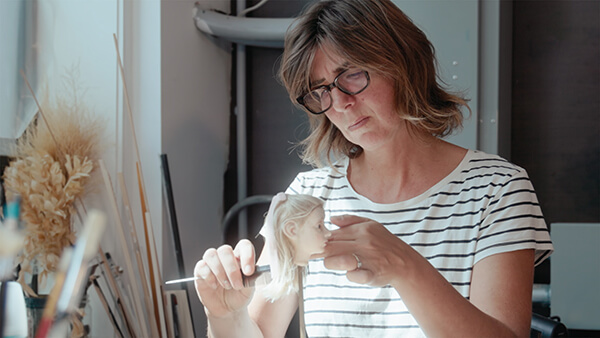
Artistic Director Brigitte Henry on Set (Credit: Martin Gros)
On that note, the production design and set craftsmanship is impeccably detailed and immersive. Can you talk a bit about working with Brigitte (Henry, Artistic Director) and the talents who constructed the environments of the film (and did you yourselves get involved on that front)?
Brigitte Henry was intimately involved in the research phase, and during production her particular responsibility was procuring props from antique markets and websites, as well as scanning or creating objects for 3D printing. She was also involved in shooting the animatic and the sets. Special mention should go to Yso South, who helped design and build most of the costumes. As with all our films, we were responsible for sculpting puppets, designing and building sets and props, lighting, and for applying the final patina, dust, and dirt to every object and character that appeared on screen.
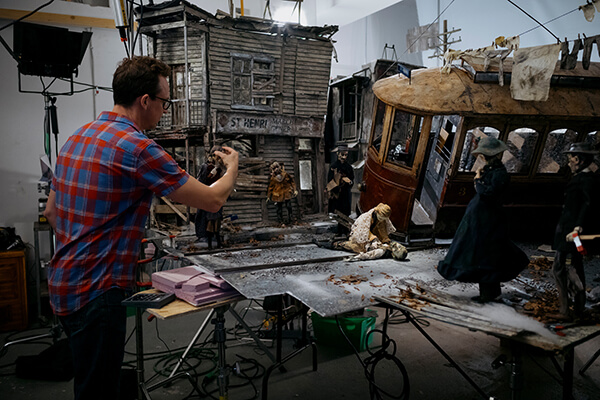
Chris Lavis on Set (Credit: Martin Gros)
I got the impression from the credits that performers were used for LAV (live action video) reference, which would account for how uniquely imbued with life the puppet performances are throughout the film. How much LAV would you say was used throughout, and was this an important part of achieving the quality of animation you had in mind for the film?
We use live action footage of actors for every scene. Our animatics take the place of storyboards, so we use them to reference gestures, camera, edits—the entire film exists in live action from beginning to end before we shoot a frame. We find this method creates, then preserves spontaneity in both the performances and the camera. For us the camera is as much an animated character as the puppets are.
To achieve this fluidity of performance, were there any special considerations or approaches when it came to the puppet armatures and materials themselves?
We have found that simple aluminum armatures are the best way to achieve fluid motion in our films. Our puppets tend to be light and quite bendable, in comparison to mechanical armatures.
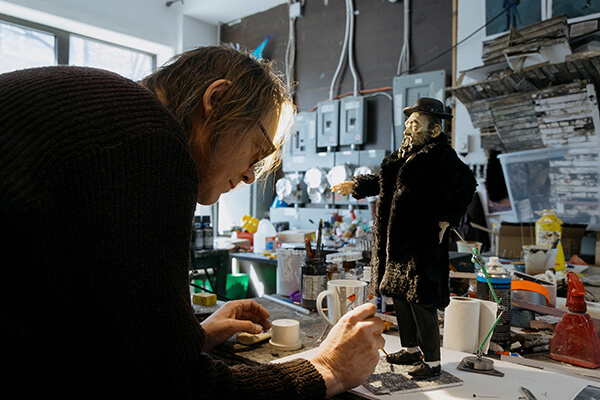
Maciek Szczerbowski on Set (Credit: Martin Gros)
There are some inevitable comparisons I can’t help but draw with Madame Tutli-Putli, though it struck me as interesting that, while that film used mixed-media to give the characters’ eyes a striking sense of life, the eyes in The Girl Who Cried Pearls are almost static, yet they still feel alive. I’d be interested in hearing about what led to this approach and how you alighted on it.
For most characters, the faces are completely static. Not even the eyes move. We wanted to prove to ourselves that we could make a puppet emote without any tricks, to show that the inherent power of a puppet has nothing to do with technology. As Orson Welles said: “Puppets are ancient entertainers. They don’t just go back to the crib, they go back to the cave.”
A similarly interesting visual choice is the absence of lip-sync, but only in the flashback sequences; was this symbolic of anything in particular?
When we recall a conversation from decades ago, we may remember some words, but we certainly don’t recall details like blinks or moving lips. Memories are not recordings, they are impressions.
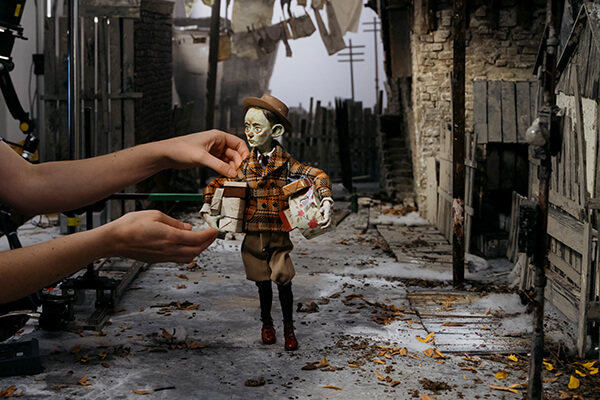
On the Set of The Girl Who Cried Pearls (Credit: Martin Gros)
Another subtle disparity between the present-day scenes is the more fleshy, organic quality of the puppets relative to those of the flashbacks, which appear almost wood-carved with cadaverous colouring. Can you elaborate on the reasoning behind this approach, and were there any specific artists or eras of filmmaking you wished to evoke with it?
They are meant to appear carved, recalling wooden church idols or well-worn marionettes. The intention was to invoke religious worship, a theme of the film, and to reinforce the idea that we are telling you a fable, the kind that may have been repeated by a puppeteer travelling from town to town.
Avoiding spoilers, the film concludes with something of a rug-pull for the audience. Was this always how you intended to go with the ending, or was it a decision that came later on in the writing process?
The decision came late. As we said before, we put the idea aside for more than a decade because we couldn’t find the ending. The ending as is wasn’t tacked on, it was the eureka moment that made the film work—a story about the very nature of stories.
As is often the case with NFB films, an English language version was produced concurrently with a French language version. How was it to direct Colm Feore and James Hyndman as each respective narrator, and did they have any interaction with one another to ensure the character was portrayed consistently across both versions?
James Hyndman’s French version came before Colm’s, but really, that made no difference. Each actor defined the role in their own way, and each interpretation is unique to that version. As for directing them, these are two absolute masters, we didn’t direct so much as nudge them a little this way and that, to make sure we had some options in the editing room.
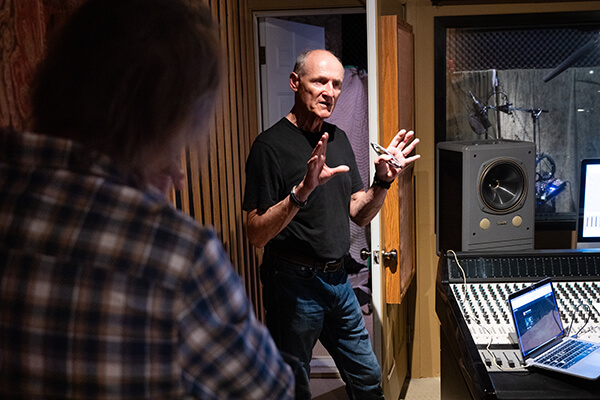
Canadian actor Colm Feore lent his voice to the animated short The Girl Who Cried Pearls (Credit: Scott McQuarrie)
As an extension of that, and as a curiosity, were the scenes that involved lip-sync animated to one specific performance that the other actor had to then time his to?
Each actor got to do their own thing, as long as they kept to the length of the shot. The French and English mouths were animated separately, in post-production. It’s not a dub, but two separate films.
I thought the work that Patrick Watson brought to the film was really strong, and seemed to extend beyond a musical score to elements that played off of the sound design and specific, individual sound effects. Can you tell us a bit about your working relationship and what sort of back-and-forths you may have had to achieve this?
Patrick has been a wonderful collaborator over several films. There are instances where the music and the sound design are indistinguishable, which is a testament to the collaboration between Olivier Calvert, the sound designer, and Patrick, the composer. Ideally, that’s how it should work, you don’t feel the work of one or the other is dominant. Patrick also helped us make some crucial editing decisions during the process, suggesting we cut three short scenes to help streamline the story.
The film will next screen in the UK at Manchester Animation Festival this month, how have you found the festival and audience response to the film so far?
The response has been very positive. We are proud of this movie. It is, to the frame, exactly the film we wanted to make. Its flaws are our flaws, this is the best we could do. To see it resonate with so many people, and to see the film appreciated not just for the visuals, but for the story, has been wonderfully gratifying.
The Girl Who Cried Pearls plays as part of MAF’s Animation Mixtape 1 screening, both as an in-person event (Nov 12 8:30pm, HOME Cinema 2) and online (available Nov 14-30)