

NFTS Director Fanny Capu on ‘Pickled’, Family Hoarding and Creating a “Cosy Goth” Stop Motion World

With the 79th edition of the star-studded Cannes Film Festival set to begin on 12th May, the famous red carpet will welcome not only Hollywood A-listers, but also a group of talented filmmakers from the globally-renowned National Film and Television School. The team will attend the world premiere of their graduation film Pickled, created during their final year at the NFTS.
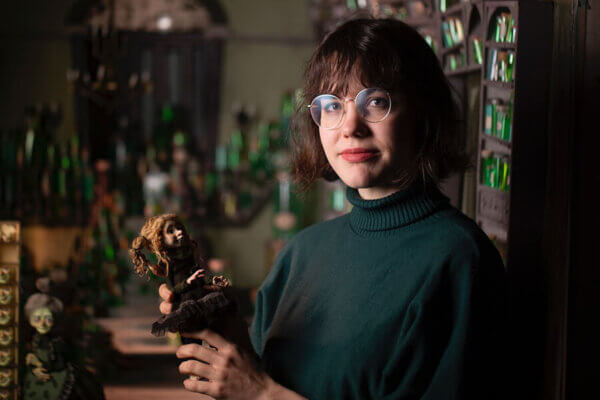
Fanny Capu on set, holding main character Eddie
The eight-minute stop motion animation explores a deeply personal story of family legacy, capturing both the joy it brings and the weight it can carry. Produced by Dóra Gálosi, the film grew from an idea that first came to director, Fanny Capu while standing in the house where her grandmother had lived her entire life – as had the generation before her. Surrounded by rooms filled with objects untouched by time, Fanny began to imagine the world that would eventually become Pickled.
Ahead of the film’s premiere in Cannes, Skwigly sat down with Fanny who studied Directing Animation at the NFTS for two years before graduating in March, to find out more.
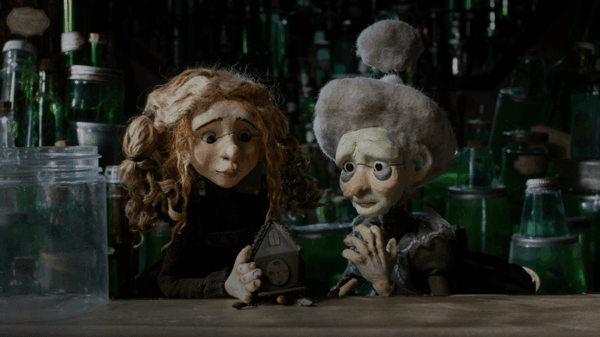
Characters Eddie and her grandmother, Pickled (2026)
With your background in model making and your time at Aardman, you’ve been heavily involved in the ‘making’ side of animation, but at what point did you realise you wanted to move into directing your own films?
I think very early on in my career, long before Aardman I have always wanted to tell my own stories and create my own characters. I started off as a kid, building my own toys and coming up with worlds for them to exist in and storylines to experience like all kids do and then I guess I failed to grow up! It’s still all I want to do – create worlds and characters, build my own toys and then watch them exist. Across the making of Pickled specifically, I have really found incredible joy in coming up with shots and the film’s language. Film language in general is something kind of complicated and abstract until you get into it and then it is the most fun part of the process for me now. Coming up with the story is one thing but then finding the way to tell it visually and in this case, entirely without words is a entirely different challenge and one I had a lot of fun with.
You mentioned pushing yourself technically with the puppets, especially in making them emotionally dynamic. What was the most difficult moment in bringing the protagonist, Eddie, to life?
The hardest thing to figure out was her hair. I really wanted Eddie to feel like she doesn’t really belong in the world her grandmother is creating while grandma fits perfectly, with vertical hair for tight spaces and green skin. Eddie seems more foreign, her hair is a reddish colour that slowly fades in the lighting of the film, like she is the last piece of sunlight slowly suffocating. I also wanted it to stand up on her head horizontally to take up as much space as possible. Eddie wants to move so even her hair is demanding space but then there are the scenes were she needs to feel suffocated and small. I had this crazy idea; ‘what if Eddie’s hair can move up and down like a dog can move their ears to show emotion?’ Hair hanging low is sad and scared. Hair perky and up is happy and content. It took quite a lot of finagling with 3mm wide tiny metal joints (that the hair was styled around) to give it the ability to move pigtails up and down. But the result is so worth it, she is definitely the most emotionally expressive character I have ever created.”
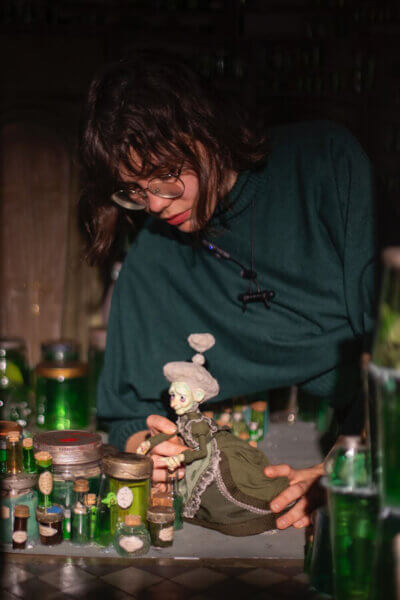
Fanny Capu animating grandmother character, Pickled (2026)
You’ve said the idea for ‘Pickled’ came from standing in your grandmother’s house, surrounded by generations of accumulated objects. How did that experience evolve into something as visually symbolic as pickling?
I think there are many reasons why people hoard. But the one that fascinates me the most is the need to preserve. The things my own grandma used to hoard, us kids were not allowed to touch because that could destroy them – they needed to be preserved. Even the stairs were covered up with ugly carpet to preserve them – but for what? I guess that is the question. What is the point of preservation for the sake of preservation? And what do you do if in your act of preservation, you make the things you’re preserving unusable. That is what pickling objects would do. Sure, it might preserve them forever but it also robs them of their function. Car keys in a pickle jar no longer open cars, glasses no longer let you see, a coat no longer keeps you warm and so on. Going off this idea was the question, what is the opposite of preservation and stillness? Dance and movement is something that can’t be preserved, only experienced in the moment. So that is what our main character wants to do, she dances.
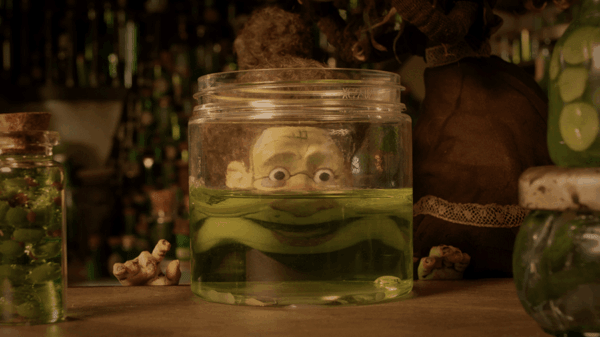
Shot from Pickled (2026)
I love the way you show Eddie growing up from girl to woman, by jumping on the stool while she is helping her grandmother. How did you come up with that as a way of showing time passing?
I was in a story tutorial while at the National Film and Television School (NFTS). We had a lot of them during my time there and they are incredibly helpful but can also be quite challenging. You get a lot of input from many different people who all see their own version of the film and pull you in many different directions. You have to learn to navigate all of those thoughts and opinions and figure out how they suit the film best. One of the suggestions I got was that we should see Eddie grow up in this house to show her history in it.
The idea was a montage of pictures on the wall to show the characters at various stages of their lives and see Eddie develop and grow up. It would have been incredibly difficult to actually pull off as I would have had to create many different puppets and scenarios to take pictures of. It’s also a shot we have seen many times before so I was trying to figure out an easier way of achieving the same thing but in one shot and with the least number of complications possible. This shot just then materialised in my brain. It’s nice and simple and only required some basic wire puppets – they didn’t even need heads and only had to look good from behind so it was perfect. That’s how I learned complicated suggestions can have very easy solutions!
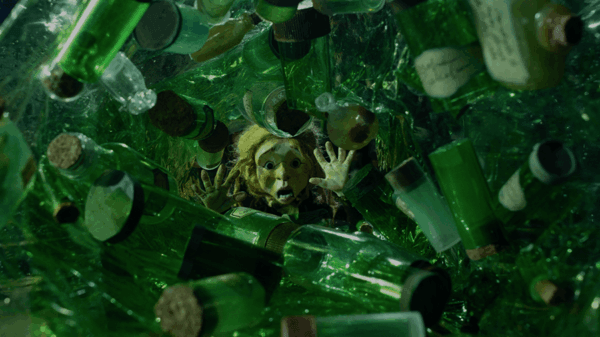
Shot of Eddie amidst a sea of pickled jars, Pickled (2026)
Some of the imagery and scenes are rather dark and could easily fall into horror, yet the film never does. How did you maintain that balance and keep the film feeling warm and positive?
That’s such a good question and one my tutors and team members kept asking throughout the making of this. When you first pitch the idea, no one can really understand how it will end up being a rather lovely, warm family drama. Our composer Dominic Carrington once called it “cosy goth” and I love that term, it describes exactly what I was trying to do. Take the basic building blocks of classic gothic stories, the big haunted house, the family drama and then make it cute and warm and cosy. The difference is that everyone in the film is a well-meaning person. Grandma wants no harm to come to her granddaughter, she loves her and wants the best for her, her mistake is thinking she knows what will be for the best but it’s never malicious, just misguided. That’s why it never ends up as a horror film because no one in the film is doing anything out of cruelty, they just mis-understand each other.
This mis-alignment is also not really resolved and I think that’s quite a common realistic experience. We often don’t get closure and don’t have a big sit down conversation where everyone airs their grievances and in the end, everyone understands each other. Sometimes part of growing up is understanding that your parents are just people and they might be wrong about some things. Sometimes you just want to be loved regardless of whether you are understood. My mum always says about my grandma “well we just gotta love her the way she is” and that’s what Eddie does in the end and I think that’s lovely.
At Skwigly, we love to know the favourite, and least favourite part of production: what was your highlight, and your biggest challenge?
My favourite moments were getting to work with so many animators. There is nothing more magical than seeing the world and character you created come to life by someone else’s hands. That’s when they truly feel like real people because it’s no longer just me who moves them. Animators make choices I would not have thought of and so the characters do things I did not expect. I love being in the shoes of the viewer and getting to experience them that way.
Challenges are harder to pinpoint, every part or the process is wonderful and challenging in its own way. This might be a bit of a copout answer but in truth, all parts were the best. The biggest challenge I loved was creating the story. There were so many moments where it looked like it was never going to make sense and that’s scary when you have so many people depending on you. I loved the set building, we had to make over 2,000 pickling jars otherwise it wouldn’t look adequately ‘hoardery’ – it was an entirely see-through set build. The glass jars all had to be movable, lean inwards but also not topple over. It all had its challenges and amazing moments! I really enjoyed the editing process it is so nice when after about 100 shooting days you get to take your puzzle pieces and put them together before stepping back and realising you have to re-shoot at least five shots. It’s all difficult and wonderful which is what I love about it. When something is too easy I know I’m not pushing myself forward.