

Looking Back at Spirited Away’s History and Allure, A Quarter Century On

It’s hard to imagine an animation landscape that doesn’t contain Spirited Away, let alone an anime landscape without its influence. Since its initial release in 2001 and the word-of-mouth popularity that eventually led to its Best Animated Feature win in 2003, it’s been considered a touchstone of the medium for the detail and imagination imbued into every frame. A quarter of a century later, and in the wake of four subsequent films from director Hayao Miyazaki, little has changed – Spirited Away remains, in many ways, the gold standard for Japanese animation. But why is this?
Ghibli films are renowned for their ability to genuinely entertain audiences of all ages, but this doesn’t mean that Miyazaki didn’t have a particular target audience in mind. Like Kiki’s Delivery Service before and Ponyo after, which were aimed at 13-year-olds and 5-year-olds respectively, Spirited Away was inspired by a trip taken with a friend and eventual associate producer of the film Seiji Okuda, along with his ten-year-old daughter and her friends. Motivated by their vivacity and disheartened by the limited scope of the romantically focused shojo manga they were reading on their holiday, Miyazaki became determined to create a film that would resonate with what they ‘held dear in their hearts’.
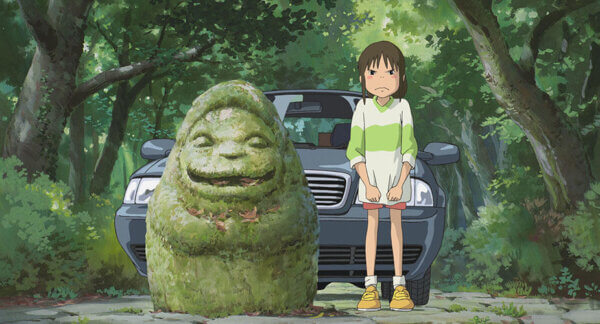
© 2001 Studio Ghibli. Still from Spirited Away.
As well as their broad appeal, Ghibli films are revered for their analogue approach to animation; however, this hasn’t been entirely the case with their production process since the early 1990s and certainly wasn’t with Spirited Away. Following the path set for Ghibli releases by Isao Takahata’s Pom Poko, Spirited Away contains moments of CGI use that complement the film’s famously hand drawn cel animation and decadently painted backdrops. The most striking of these, in my opinion, comes when Haku is leading Chihiro through the camellia and rhododendrons, in a moment of joyous sensory overload enhanced by the sense of depth the CGI provides.
Furthermore, as anime academic Professor Rayna Denison discusses in her book Studio Ghibli: An Industrial History, Spirited Away was ‘one of the first of Studio Ghibli’s films to be completed using digital, computer-based production techniques’, smoothing the assemblage of the final film. This goes to show that Ghibli, while known as guardians of animation tradition, aren’t afraid to experiment with new technologies to bring creations to life.
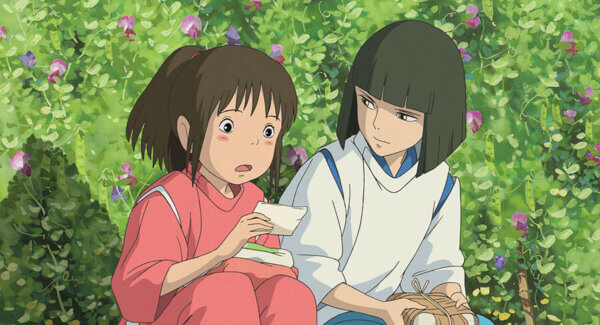
© 2001 Studio Ghibli. Still from Spirited Away.
What set Spirited Away apart from how animated films were typically perceived in the Anglosphere was the range of discourse it seemed to inspire in critics, academics, animators, and audiences alike. It’s easy to search up the film’s title in relation to almost any theoretical concept or contemporary social or political issue, from feminism and Marxism to late-stage capitalism and Westernisation, and find a highly insightful discussion on its astute commentary. It’s hard to imagine that all of this was intentional on Miyazaki’s part, but it’s a testament to how multilayered Spirited Away is that it still means so much to so many people.
Though Spirited Away is undeniably original in visuals and storytelling, this is achieved in part through a complex collage of allusions to global literature and architecture. Miyazaki had several ideas centred around bathhouses, including one based on the book Kirino Mukouno Fushigina Machi (A Mysterious Town Over the Mist) by Sachiko Kashiwaba, that he believes eventually became the foundation of the film. However, animation scholars have for a long period identified more than a faint trace of Lewis Carroll’s Alice’s Adventures in Wonderland on the story, including Amanda Kennell, who has written an entire book on the influence of this story on Japanese popular culture.
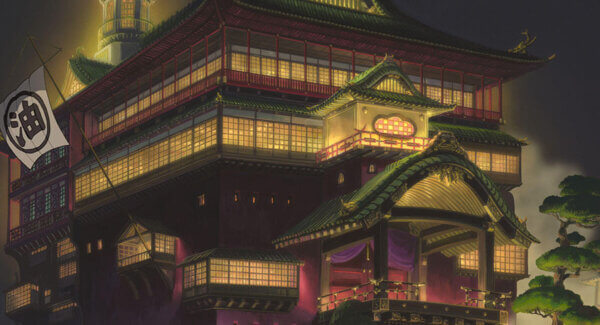
© 2001 Studio Ghibli. Still from Spirited Away.
The bathhouse itself is largely Japanese, its exterior based on the Edo-Tokyo open air museum, but areas like Yubaba’s ornate office bring in elements of Western design, specifically the Rococo style. In balancing these influences, Miyazaki produced a work that spills over with references for any audience member to grasp, or to simply get whisked away in like the warm waters of an onsen.
Aside from experimentations in the animation itself, the Disney dub too proved to be an interesting exercise, specifically in anime localisation. The Disney-Ghibli deal, established in 1996, stipulated that the Walt Disney Company received worldwide distribution rights to the whole Ghibli library, with Disney producing new dubs of all previously dubbed films. This didn’t mean that every film got the attention it deserved from Disney – infamously, Takahata’s beautiful Only Yesterday was largely brushed under the rug for its depiction of menstruation – but fortunately, Spirited Away received more than most.
Thanks largely to Pixar’s John Lasseter, a now disgraced figure in the modern history of animation, Spirited Away was given an incredible amount of care and attention in the localising, scripting, and casting of its English version. Lasseter championed the film, while screenwriters Cindy Davis Hewitt and Donald H. Hewitt matched the words of the dub script to the mouth movements of the characters for a greater sense of immersion. Daveigh Chase voices Chihiro herself, fresh off her expressive stint as Lilo in Disney’s Lilo and Stitch, while Disney regulars like John Ratzenberger and Jason Marsden were given supporting roles. While most die-hard fans are still likely to advocate for the original Japanese voice track, it’s undeniable that the quality of this dub carried the film to greater global popularity.
Though it had also picked up the Golden Bear at Berlin Film Festival and Film of the Year at the Kinema Junpo Awards, it was winning the Oscar for Best Animated Feature (the second ever to be awarded) that clinched Spirted Away’s global reputation. This isn’t to say it made an enormous splash at the box office beyond Japan – in fact, it only hit about $10 million in the states – but this sudden visibility set the stage for many future successes. The high art status of Spirited Away even led the film to be the topic of the Ghibli Museum’s first ever exhibition. However, Miyazaki insisted that the focus be on the background art by Kazuo Oga and Yoji Takeshige, rather than elements like the character designs or storyboards, bringing the film even further in line with the prestige status it had acquired.
Spirited Away’s place in other cultures outside of Japan since release is perhaps the best case for Ghibli as a studio with near global appeal. Although it had made its way into the country years prior through bootlegs, Spirited Away made its way into 9000 of China’s theatres in 2019. Accompanied by a gorgeous release poster, the film made over $70 million (seven times what in made in the US in 2003!) a result of its existing popularity in spite of, or perhaps because of, government restrictions. In a similar vein, Spirited Away has held a consistent presence in British culture in both arthouse theatres and through Channel 4’s regular Ghibli ‘seasons’, where many UK viewers have used the film as a gateway into appreciating animation as adults. Having taught an Introduction to Studio Ghibli course with City Lit in London, I can personally attest that this was the experience of many learners who’d sought out the programme to learn more after a viewing of what might well be Miyazaki’s magnum opus.
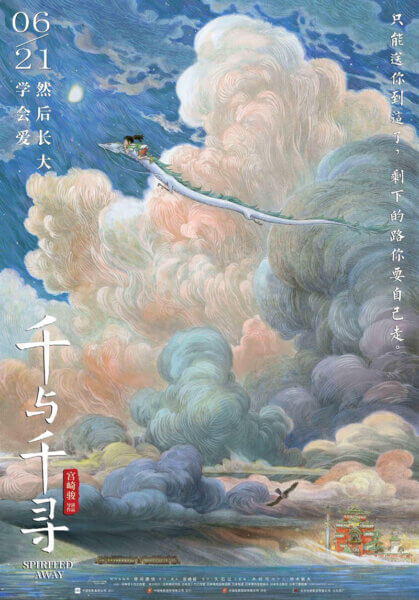
The theatrical poster used for Spirited Away’s 2019 Chinese release