

“Viva Carmen!’s Prettiness Has a Purpose” – Annecy 2026: Viva Carmen! Review

© Global Constellation
The first second of Viva Carmen! is an explosion. The sound cracks through the speakers, saturation fills the screen, the aftermath is rowdy and busy – all of the hallmarks of a classic action movie detonation. In reality, the opening frames of Viva Carmen! depict a knife slicing through the crispy crust on a loaf of bread in a bustling 1840s Spanish tavern. Except, the bread is a colour that no bread would be, neither does the person cutting it map onto any realistic human form we’re familiar with, even the table the bread is being cut on takes on an abstractness that dilates the pupils of the viewer, as if they really were watching the climax of a Michael Bay movie.
The experience of watching the other 99% of Viva Carmen! is exactly like this. Events both mundane and essential are depicted with such majesty, an art style with a gravitational pull so strong that it has you peering into the corners of this world, desperate to be a true fly on the wall of the story. Those with a keen eye on French animation will be familiar with Viva Carmen!’s style from 2023’s Annecy Cristal-winning Chicken For Linda!, directed by Chiara Malta and Sebastian Laudenbach. Carmen is directed by Laudenbach alone, but he brings with him an evolved form of the experimental artstyle depicted in Linda.
Viva Carmen! is an adaptation of the 1875 opera Carmen, something that has been adapted for the screen time and time again since the early days of the medium. If anyone was going to bring something unique to such an ancient tale, it was going to be Laudenbach. Instead of the titular character, Laudenbach’s adaptation focuses on a boy named Salvador, the assistant to an old, blind blade sharpener who gains prophetic insights into what fate has in store for the wielder of the weapon. Once Salvador learns that fate has a gruesome end in store for a local woman named Carmen, he engages in a battle with destiny to save her.
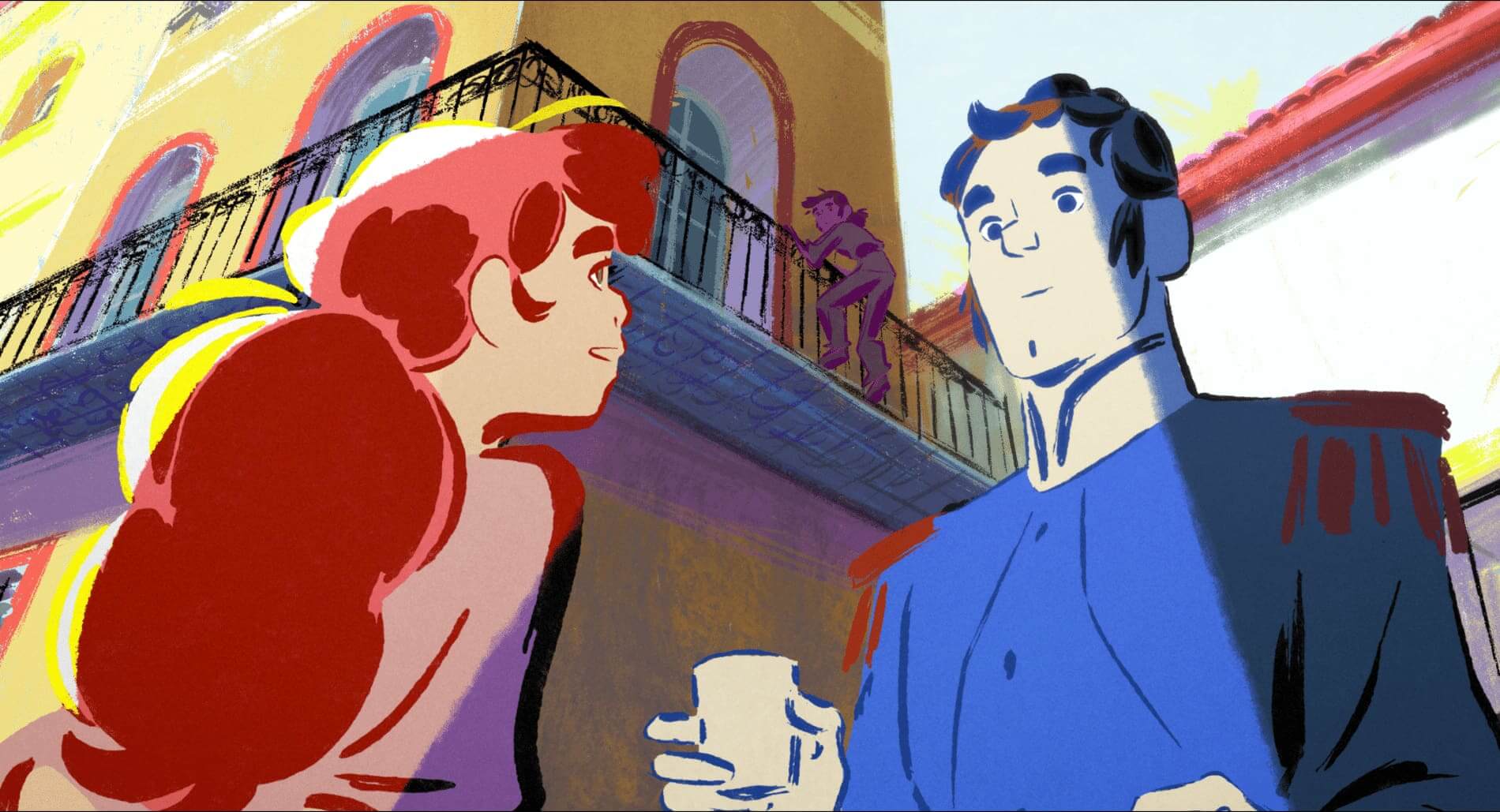
What Viva Carmen! shoots to depict, and what Chicken For Linda scarcely touches on, is nighttime and shadow. Linda mostly eschews the depiction of the shadows cast by objects surrounding the characters and is almost entirely set during daylight hours, apart from one stunning sequence set in a late car ride home. In Viva Carmen!, shadows cannot be escaped. The shapes cast by buildings, trees and other people are constantly sitting on top of our characters, a bold move in a film where colour is so distinct.
In Viva Carmen!, human skin tones aren’t a thing, at times neither is the human form. Laudenbach’s style abstracts the shape of a person so far beyond what should be recognisable, yet each character feels human, their emotions easily communicated. People are simply made up of block colours and thick, loose outlines. Salvador is often depicted between the ranges of a plumb purple and a bronzish yellow, where he lies on that spectrum depending on how much shadow he lies in. All of the characters exist on their own spectrum of colour throughout the movie, a big change from Chicken For Linda where each character would own a colour, the audience able to understand who is who based on that alone. Viva Carmen! abides by this one law of physics – that colours change in shadow, in sunlight and in moonlight.

© Global Constellation
That inconsistency is a huge part of the thematic underpinning of Viva Carmen!. One colour cannot be used to describe a whole person the same way that a single adjective couldn’t describe your whole personality. Viva Carmen! is about the shades that exist within us, our capacity for good and evil that can lie dormant, no matter how much that varies from our outside perception. Salvador may seem like a peasant assistant to an old man, but is shown to have an incredible musical bent. His friend Belén is mostly shown as a heartless thief, but is revealed to have depths to her emotional capacity we would never expect. Viva Carmen!’s prettiness has a purpose.
It is during those nighttime scenes where the visuals become more than just pretty frames from a movie and become astonishing standalone pieces of art. One conversation between Carmen and her lover José is framed in an unforgettable way. Carmen atop a bell tower, José speaking through the bars of a jail cell, a gap between them filled by the purplish blue of the sky – it’s majestic.
While its visuals and subtext remain compelling throughout, Viva Carmen!’s actual text feels much weaker. In his attempts to avert fate, Salvador learns to let go and understands that fate is inevitable, that there’s fear, but also comfort, in knowing that certain things are preordained. There’s nothing wrong with that message, but it is unsatisfyingly stated at the end of the movie.

© Global Constellation
Viva Carmen! also falls into a trap laid for many adaptations of very old work where the events of the story are so familiar that the film doesn’t feel the need to explain why they happen. For example, we know that Carmen and José fall in love, but little effort is put in to depict the details of that romance. This makes the characters feel weaker and the passion that the story should have ended up feeling too contrived.
It’s possible that none of these problems feel urgent while watching Viva Carmen! because everything else about it is so entrancing. Whether it’s the act of bread being sliced, or a standoff in the town square, the abstract, sketchy, colourful, constantly shifting look of Viva Carmen! makes it one of the most fascinating and accomplished films to grace this year’s Annecy programme.
Viva Carmen! is scheduled for theatrical release in France on December 16, 2026. Official theatrical release dates outside of France have not yet been finalized.