

A.I and Animation – A Call for Understanding

There is a palpable fury when it comes to the topic of Generative A.I (GenAI) and animation. Cries in the comments of ‘they’re after our jobs’ and the hours of A.I slop videos that ooze across our social media timelines create the idea that A.I. is out to suffocate or replace animation entirely.
Animation artists and fans are right to be concerned about A.I. GenAI is contributing to the scarcity of animation work, capitalising on looking like hand made animated content as a selling point. This is a trend Ben and I discussed on a recent Skwigly podcast with ‘claymation’ or cardboard styles rapidly emerging, which on the surface look like they were made with love and dedication, but the trained eye can see that they are littered with inconsistencies that have slipped by the platforms’ detection systems. The GenAI equivalent of the uncanny valley.
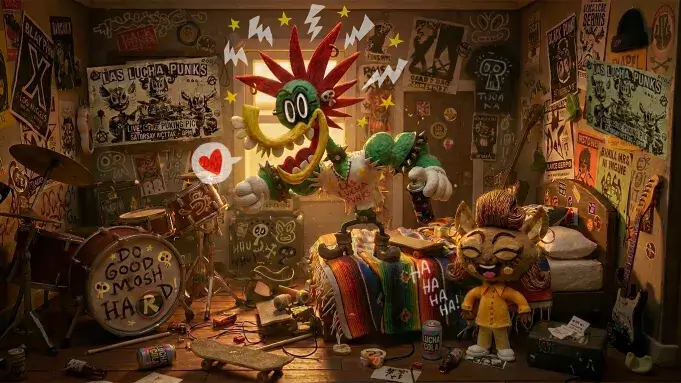
Punky Duck –
Amazon MGM Studios
Recently the world of animation turned its wrath towards Jorge Gutierrez in an uncharacteristic way. Gutierrez was announced as a participant in Amazon’s new GenAI Creators’ Fund. After running a gauntlet spanning disappointed fans through to hyperbolic Insta/Tik Tok commentators, the pushback escalated to Gutierrez and his family receiving death threats. Shortly afterward, the director decided to pull out of the programme and abandon his series Punky Duck. Apart from a single image released from the now cancelled project and a promise that the project existed to showcase “artists driving tech, and not the other way around’, there was no understanding how Gutierrez was set to use generative A.I in his series. However the term ‘GenAI’ alone was enough to unleash bloodthirsty disdain from the online animation masses.
How did we get here as an animation community? Whatever happened to the ‘don’t be a dickhead’ mantra that has sustained many a long career? If vocal actions against GenAI are designed to protect the artists, how is sending an artist death threats achieving that? A.I has poisoned our priorities and social media has ballooned both A.I’s prominence and given us the facility to publish harmful retaliatory words we wouldn’t use face to face. Words with real consequences as a family are put at risk. Death threats are inexcusable, they are not holding someone ‘accountable’, especially an artist who has a history of providing some of the most human ideas in modern animation.
The Gutierrez situation has demonstrated an unnerving issue with the conversation on GenAI and animation, particularly online. Go to any animation event and you will find kind, courteous people all passionate about the work of animators and artists. A.I has been sold across many art forms and industries as a ‘disruptor’; certainly it is disrupting the marketplace, but it would be a woeful mistake for our community to let it disrupt our way of being and turn us into a rabid, hate-filled mob.
This isn’t a call to support GenAI. It’s a mission to save the soul of our animation community and come to an understanding.
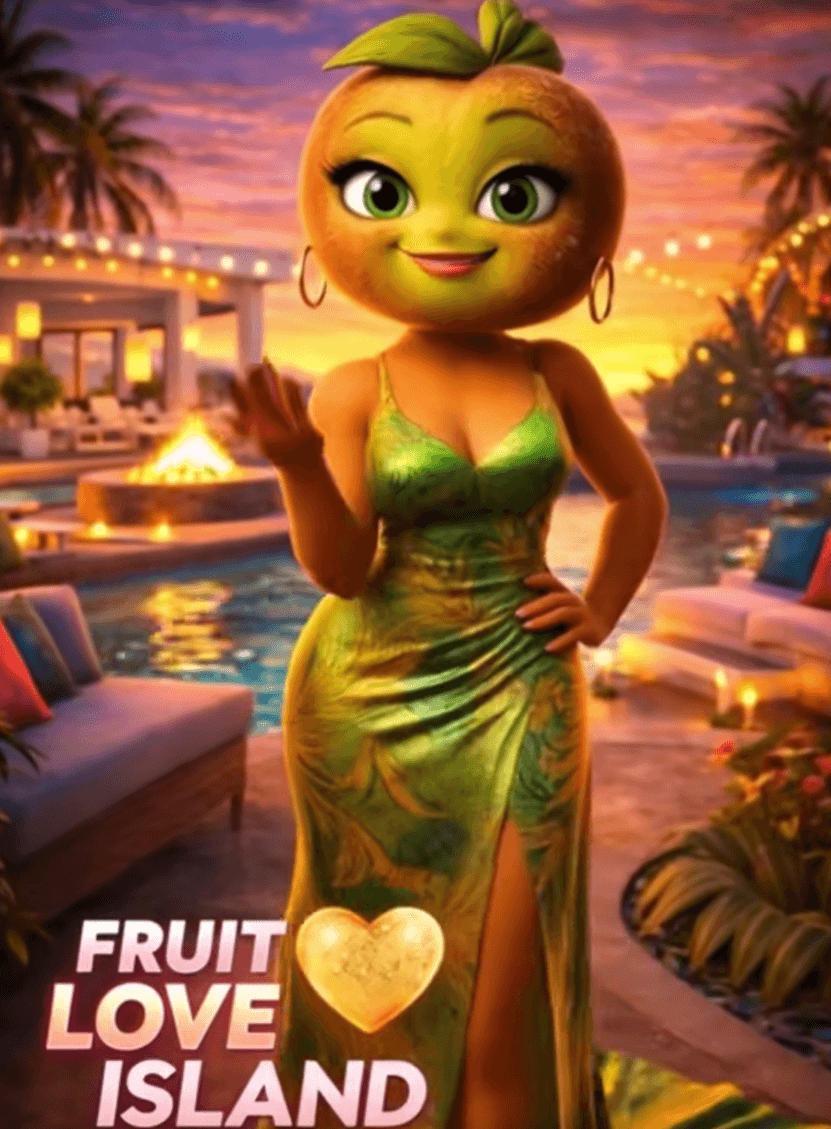
Gutierrez’s difficult u-turn will have satisfied some, whilst others will remain disappointed – but the overall incident won’t turn the tide on the continuing rise of GenAI videos. The sizable audience of Fruit Love Island, before production was halted back in March, shows that hundreds of millions of viewers are clearly happy to watch these “A.I. slop” videos and don’t care how many gallons of water it took to produce a dribble of entertainment.
As terrible as this picture is, there is one realisation I am keen to share which helps soothe my own GenAI woes – that, as hard GenAI tries to be animation, it is not animation.
Once we view the products of GenAI as something different from animation as live action filmmaking is, then we can begin to regain focus and reclaim what animation means. There are, however, some hurdles we need to overcome to fully understand this.
“BUT IT LOOKS LIKE ANIMATION”
You’d be hard pressed to come up with a better name for the art form we call animation. Etymologically speaking, it is perfect. Coming from the latin word anima, meaning ‘breath’ or ‘soul’. Animation is living and it is the artists that breathe life into their creations.
Whilst the argument “GenAI looks like animation so it must be” is a compelling one, consider CGI stunt doubles. They look exactly like live action stars, but we wouldn’t consider digital versions of Hollywood’s finest being chucked into harm’s way as actors would we? Much the same way we shouldn’t consider A.I talking fruit shagging on an island as animated. (Did I really just write that last sentence? I guess I did.)
Fruit Love Island (Wikipedia)
The hard part for our community is accepting the fact that GenAI can produce a finished product that, up until this point, only animation could produce.
Though it may look ‘created’ the process of creating images using GenAI is much further removed from traditional methods. After receiving instructions from a user, generative models search and gather numerical data points from billions of targets, searching for commonalities. If you ask for a picture of a red apple, the training data will have identified millions of instances of what ‘picture’ ‘red’ and ‘apple’ mean and will draw from some of those instances to produce it’s own amalgamated version of a picture of a red apple. The numerical data points have delivered a calculation of what the user has requested.
The output is made without the ‘breath’ and the ‘soul’ that makes animation unique. Do these animation lookalikes have an audience? Yes, but so does live action, and we are rarely concerned about live action taking away animation viewership.
PIPELINE PROBLEMS
Aside from the GenAI videos where a prompt becomes a video, A.I in the broader sense has infiltrated most systems animators use. From sketch through script to screen, A.I is everywhere. Spell checkers, voice recognition softwares, auto editors, emails, researching using search engines – it isn’t just about using a LLM to write a script, our entire pipelines have A.I woven throughout them. There are very few softwares left that offer a clean break from A.I. Industry leader Toon Boom has integrated generative A.I in its production software. However Moho, a mesmerising piece of software often accused of being A.I, has taken the opposite stance against A.I integration. Whilst Moho can assure us that the animation produced on that software is made by humans, that won’t stop the rest of the pipeline beyond Moho being assisted with A.I. With this in mind, where do you draw the line with A.I in your production pipeline? At what point does an animated film become A.I?
Searching for the answer is a puzzle for armchair philosophers, reaching for the Ship of Thesus thought experiment; imagine an animated production pipeline laid out from start to finish – how many departments or processes do you replace with A.I before the production becomes an A.I production? Which elements make it unique to animation?
Let’s complicate this further and look at one part of the process – character animation. A.I has increasingly been used as a render engine, taking hand made animation or a play blast and then using A.I to regenerate that animation in a different style, such as Dear Upstairs Neighbour. The animation is still human made, but the final lick of paint was generated using A.I. Is this animated or another GenAI slop video? Would it be more animated if Renderman added the final lick of paint? What if an artist takes the opposite approach and creates a lavishly detailed character design and gets A.I to do all the rigging, movement and animation? Which of these two processes can be considered more animated?
Does using any A.I in an animation production disqualify it from being considered animated? Aardman famously uses live action reference to help guide their animators, but we wouldn’t confuse matters by considering their films to be part live action. If they used A.I instead of live action, would we be as quick to disqualify those films as animated? Perhaps, the human element of both the live action reference acting and the completed animation preserve the artistic vision in this scenario.
There is an emerging spectrum for hybrid animation/A.I work with artist led on one side and A.I led on the other with which all future productions will be measured. Hybrid workflows seem to be inevitable, at least that is what the majority of software sales people are telling us, but there are organisations working to preserve the sanctity of human made work. Launched earlier this year, Human Made Mark are working on a certification that will be awarded to productions that can prove their human credentials, acting like a fair trade logo, but for film production.
Returning to our vocal, anti-A.I audience, Human Made Mark may well provide both a distinction and a prestige that informed audiences will crave in future and a badge that productions can aspire towards.
THE FILM FESTIVAL DILEMMA
A.I has changed from being an option to an unavoidable add-on in all aspects of our lives:, GenAI films are here to stay. More of these films are being submitted to film festivals than ever before, creating issues for programmers.
With each festival relying on their own policies, there isn’t a unified stance on dealing with this conundrum (though in my role as Manchester Animation Festival Director I have begun developing one). Some festival directors see GenAI films as animated, others wish to see how the conversation evolves. This is confusing for both filmmakers and producers of GenAI content, as well as festival audiences wishing to make an informed decision. If animation festivals were to decide that GenAI content is a separate form of filmmaking then it becomes clear. Whatever policy each festival holds for animation/live action hybrid films becomes adaptable for animation/A.I films. A fully generated A.I film would be accepted to an animation festival as much as a live action film would be (i.e it won’t) Whereas a film using an A.I render engine and proves its pipeline would be seen as a hybrid film and given the same reverence as a live action/animated hybrid film.
Though some film and animation festivals are still allowing A.I films to be submitted, the separation is gaining traction and the live action world is making great strides to combat the infiltration of GenAI in their world. The Academy of Motion Picture Arts and Sciences recently clarified their rules to ensure that both A.I actors and A.I writing are ineligible for the Oscars and, whilst the Academy still separates its animation and live action award categories, specifically excluding A.I divorces it from both animated and live action filmmaking entirely in the eyes of the Academy. We shall see how the GenAI community reacts to this exclusion, but there are GenAI film festivals that exist so that prompters can compete in their own A.I events and not have to feel too downhearted at wasting minutes’ worth of work.
GenAI feature films have begun flexing their muscles, a cheaper alternative to using human artists, and the results are infiltrating high-end events. Critterz, the Open A.I funded film, found itself at Cannes this year, albeit at the festival’s marketplace Marché du Film and not to the heaving standing ovation distributing auditorium you might expect when you hear ‘screening at Cannes’. It’s an old trick used in film sales and nothing new to A.I filmmakers.
The Marché du Film has hosted multiple talks this year on A.I in filmmaking, making a film like Critterz feel at home. Their carefully worded press releases may give the illusion to the layperson of a film celebrated by red carpet fanfare, but in reality the incomplete Critterz is aligning itself with the prestige of Cannes to sell itself to distributors. It might be a film, like any other being sold at the marketplace – it is, however, not animated.
GenAI’s claim to the word ‘animation’ is getting weaker and weaker. It’s up to us to prise its fingers off and force it down its own path.
HOW DO WE RESPOND?
For as long as reasonably successful GenAI videos have been around, ‘Pixar’ style clips and images have been doing the rounds. ‘Pixar’ style being a catch-all for a homogenous assimilation of a variety of studio styles, but your average consumer in need of a video with no care of its origins doesn’t have the bandwidth to request a video in the style of Illumination, as it would take precious seconds to understand that the people who made Minions and the people who made Toy Story are not the same company.
This ignorance is dangerous, with penny-pinching commissioners seeing savings rather than teams of artists going without work. Animation professionals themselves are falling into the trap of declaring A.I as animation. GenAI has been called ‘the fast food of animation’ and, whilst that is an easy to digest analogy, it is entirely wrong. Such comparisons join A.I and animation at the hip, raising A.I up and dragging animation down to its level. Calling GenAI ‘animation’ simply because it looks like animation does not make it so, just as me being able to move my legs does not make me a Prima Ballerina.
So how do we respond? We need to become stricter with our terminology. We correct with kindness. Not just correcting the creators looking to claim that their work is animated, but the commentators, journalists and anyone else making the mistake. It is our role to educate and enlighten.
It’s tempting to bundle animation into the A.I argument when the word “film” is used. But remember film is simply the mechanics of what we see on screen. Since both live action and animation film emerged at roughly the same time, in the late Victorian era, we’ve not experienced a new form of screen entertainment emerging and establishing itself at this scale – so understanding where to put it among our existing understanding has proved a challenge.
GenAI is now established. We cannot stop it from being produced. We can however stop it declaring itself to be animation or live action in simple terms. With the rapid growth of GenAI and understanding how it is made it is clear there are now three distinct categories of film which present motion in different ways.
Animation creates motion.
Live action captures motion.
A.I calculates motion.
Giving GenAI its own space allows animation and live action to thrive. It forces GenAI to develop its own prestige and culture rather than hijacking existing models in an attempt to absorb them.
This article hasn’t been written to either address or excuse the copyright, modern day slavery, environmental or other pertinent issues that GenAI presents. Those are inexcusable challenges that A.I platforms still need to be held accountable for. This article has been written to encourage the animation community to unite around a definition for A.I so we can divorce it from animation.
GenAI has arrived to disrupt our industry and then to benefit from that disruption. The animation industry is only as good as the people in it, and every time we fight and get angry at one another we are fueling a monster that thrives on exposure. Reminding people of the correct terminologies and promoting an understanding of what ‘animation’, as an art form with life, breath and soul can all be done with kindness, without anger and without the disruption that continues to put the spotlight on A.I and not the artists.
We can do better. We must do better.